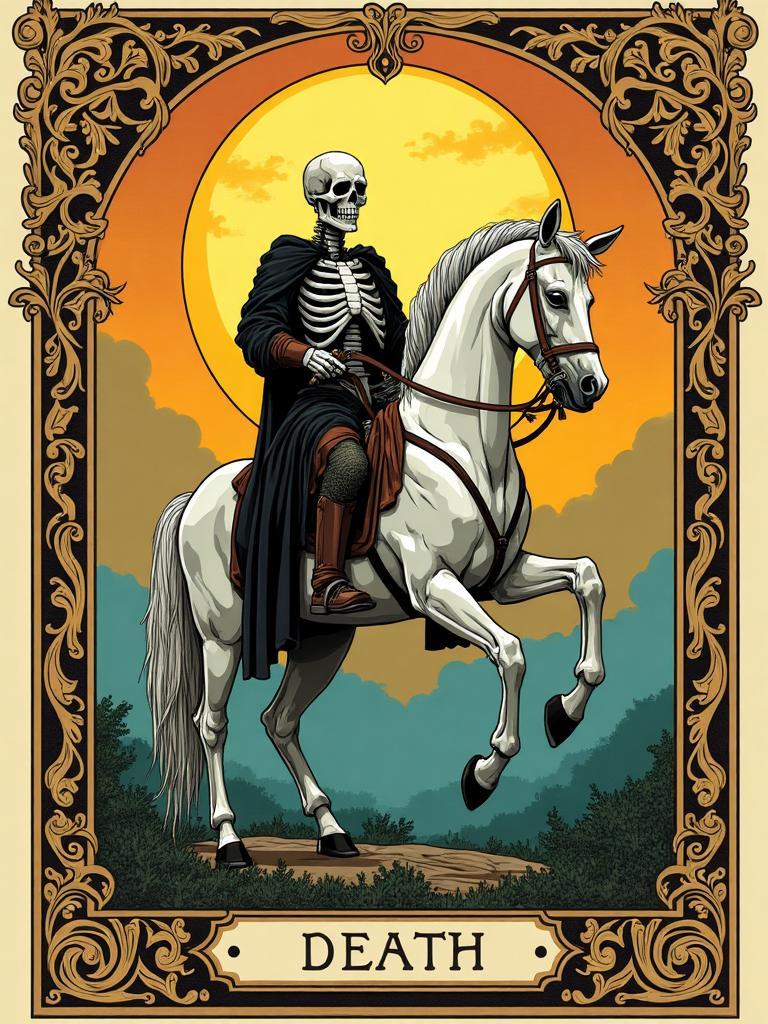
Death – Tarot Card Meaning
Explore the psychological depth of the Death Tarot card. Learn about transformation, letting go, and the power of renewal in this expert lexicon entry.
Core meaning
The Death card represents the profound principle of transformation and the natural conclusion of a cycle. It signifies the necessary ending of a situation, habit, or phase to clear the path for essential renewal and new growth.
Death upright meaning
One chapter ends, another begins. Death symbolizes profound transformation—not physical ending, but necessary change.
In the garden of existence, death feeds life. What falls away creates fertile ground for growth.
The old self must die for the new to be born. Embrace this metamorphosis with courage.
Death reversed meaning
Resistance to necessary change. Holding on to what no longer serves.
Transformation delayed is not transformation avoided. The change will come.
The death that is resisted becomes suffering. Let go of what has already ended.
Death in love
End of a phase or deep transformation in the relationship.
Relationship metamorphosis is underway. Trust the process of renewal.
Death in career and finances
Career change or end of a project. Room for the new.
What ends in your career creates space for what's meant to come next.
Death spiritual meaning
Spiritual death and rebirth. Deep inner transformation.
Profound spiritual metamorphosis is unfolding. You are becoming who you truly are.
The card's advice
Let go of the old to make room for the new. Transformation is growth.
Release with gratitude what has served its purpose. New life awaits.
Death: yes or no?
No. In a yes/no question, Death leans towards no: look at what is holding you back or warning you.
Reflection
Psychologically, Death embodies the archetype of transition and the ego's confrontation with impermanence. It invites us to examine our resistance to change and the parts of our identity that have become stagnant or obsolete. This card reflects the process of 'psychological shedding,' where old belief systems or emotional attachments must be dissolved to facilitate further individuation. It highlights the discomfort of the liminal space—the void between what was and what is yet to come. Embracing this card means recognizing that every ending is a prerequisite for a new beginning, requiring the courage to let go of the familiar to allow for a metamorphosis of the self.
Typical questions
- What aspect of my life or identity has reached its natural conclusion and needs to be released?
- How does my fear of loss prevent me from embracing necessary psychological growth?
- What space would be created in my life if I stopped clinging to the past?
- Which old habits or behavioral patterns are currently hindering my development?
- In what way can I honor the ending of this cycle to ensure a healthy transition into the next?
What it does not mean
This card does not predict physical death or literal tragedy; it functions strictly as a metaphor for internal and systemic shifts. It is not a 'negative' omen or a sign of bad luck, but rather a neutral representation of the natural law of change. One should avoid interpreting it as a fixed external event, focusing instead on the internal process of letting go and the potential for rebirth.
Death symbolism: what the card shows
Card XIII in the classic Rider-Waite-Smith deck shows a skeleton in black armour riding a white horse. It carries a black banner marked with a white five-petalled rose. In front of the horse, a king lies on the ground with his crown fallen beside him, a churchman in a mitre stands with his hands joined, and a young woman turns her face away while a child looks up at the rider. Behind them a river runs with a small boat on it, and on the horizon the sun stands between two towers.
Nobody in the scene can stop the rider, whatever their rank or age: change reaches the powerful, the devout and the innocent alike. Yet the image is not only about loss. The white rose on the banner is a traditional symbol of purity and renewal, the river keeps flowing, and the sun on the horizon shows that a new day follows the night. Death in tarot marks the moment a chapter closes so that the next one can actually start.
Death reversed in love
When Death appears reversed in a love reading, the ending it describes has usually already happened in substance but not in practice. A couple might still share a flat, a calendar and a streaming account while both quietly know the relationship has run its course. Or the bond is alive, but one phase of it is not: the honeymoon period, the long-distance arrangement, the way you used to handle money. Clinging to that form keeps both of you from discovering what could come next.
For singles, the reversed card often points to an ex who still takes up room: their photos, a shared group chat, the habit of comparing every new date with them. It can also describe holding on to an old idea of yourself as "bad at relationships". The card invites you to close one door on purpose, gently. For the upright meaning, read Death in love and relationships.
Death as feelings
If you ask what someone feels for you and draw Death, the card tends to say that their feelings are in transition. Something has changed for them, and they may not yet have found words for it. In a new connection, this can mean the person is letting go of an earlier relationship and is not fully available yet. In an established one, it can show that their love is changing shape, for example from infatuation into something quieter, or from a romantic interest into friendship.
Reversed, Death can suggest feelings the person is holding on to out of habit or fear of the gap that would follow. It is a tendency worth reflecting on, not a verdict on someone's heart. Only an honest conversation can tell you where they really stand.
Death: yes or no?
No – Death answers a yes or no question with a no, at least to the version of the plan you are asking about. Its message is that something has to end before anything new can begin, so asking "Will this go back to how it was?" usually gets a clear no. Reversed, the answer stays no, and the card adds that the resistance comes partly from you. It is especially helpful for questions about whether to hold on, renew or retry. You can put your own question to the yes or no tarot with one card.
Death as your card of the day
As a daily card, Death rarely means anything dramatic. More often it points to a small ending that frees up energy: unsubscribing from a newsletter you never read, deleting an app that eats your evenings, or finally answering "no" to a request you have been dodging. Watch today for a moment where you notice that something is simply finished. Rather than fight it, acknowledge it and let it go. One practical step: clear one drawer, one inbox folder or one shelf, and leave the space empty for a day. When you want tomorrow's card, the daily card is free to draw.
Death as a person
As a person, Death describes someone who is good at closing chapters. They can leave a job, a city or a friendship that no longer fits without endless back-and-forth, and they often help others through transitions with calm, practical honesty. People call them when a business needs restructuring or a family needs someone to sort out an inheritance. Their strengths are clarity, courage and a lack of sentimentality about what is over. The shadow side is a certain coolness: they may move on before others are ready, or cut ties where a repair would have been possible. When the card describes you, ask whether you are ending something or avoiding it.
Death for health and wellbeing
For wellbeing, Death speaks about habits that have reached their natural end. Perhaps a training routine that suited you five years ago now leaves you sore and unmotivated, or an evening ritual has turned into scrolling until midnight. The card encourages you to let go of one routine that no longer serves you and to give your energy time to settle before replacing it. Transitions of any kind, a move or a new job, can also be tiring in themselves, so plan extra rest around them. Please treat the card as food for thought rather than medical guidance; health concerns belong with a doctor.
Death as your year card
A year under Death often closes a long chapter. Typical themes are leaving a job you have outgrown, ending a lease, finishing an education or letting a relationship change form. The first months can feel empty, but by the end of the year many people find they have room they did not have before. You can work out your year card by adding your birth day and month to the year and then adding the digits of the result until you reach 22 or less; 22 counts as The Fool (0). For example, a birthday on 12 August gives 12 + 8 + 2027 = 2047 → 2 + 0 + 4 + 7 = 13, Death. Let the year be one of clearing out, not of loss.
Death affirmation
"I let what has ended be finished, and I trust the space it leaves behind."
"Every chapter I close gives the next one room to begin."
Death: frequently asked questions
Does the Death card mean someone is going to die?
This is one of the most searched questions about tarot, and the honest answer is no. In the Rider-Waite-Smith tradition, card XIII is read symbolically: as the end of a phase, a role or a way of living. Reading it as a literal prediction misses what the image itself shows, with the sun rising behind the rider. If the card frightens you, ask what in your life is ready to close.
How is Death different from The Tower?
Both cards describe endings, but in very different ways. The Tower is sudden and comes from outside, like a lightning strike that brings down a structure overnight. Death is slower and more natural, like a season turning: you can often see it coming and walk through it step by step. Seen together in a reading, they suggest a major shift that is both unexpected and long overdue.
What does Death mean next to the Six of Cups?
The Six of Cups is a card of memories, childhood and the past. Beside Death, it often points to saying goodbye to something you have been nostalgic about: an old relationship you still romanticise, a childhood home, or a version of a friendship that belongs to earlier years. The pair invites you to keep the good memories and still let the situation itself go.