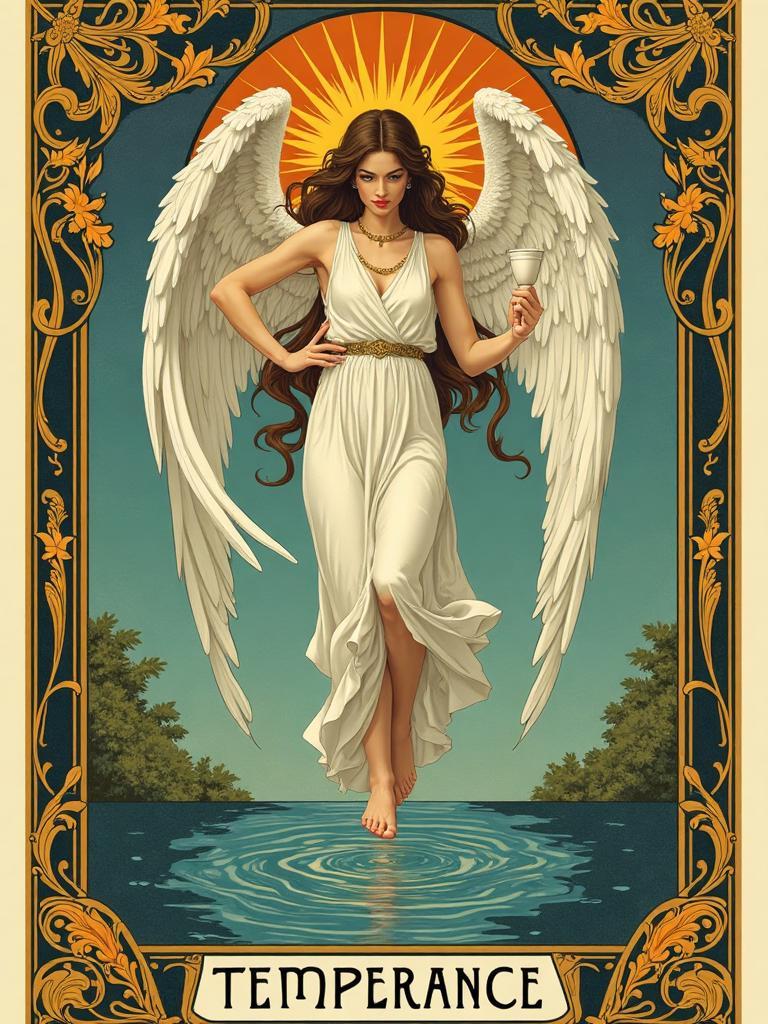
Temperance – Tarot Card Meaning
Explore the psychological depth of the Temperance Tarot card. Learn about inner balance, alchemy, and the integration of opposites for personal growth.
Core meaning
Temperance represents the principle of dynamic equilibrium and the conscious integration of opposing forces into a harmonious whole. It signifies the alchemical process of moderation, where different aspects of life are blended with patience to achieve internal stability.
Temperance upright meaning
Balance and patience lead to the goal. Temperance calls for the golden mean—integrate opposites and proceed carefully.
Harmony emerges through careful calibration. Pour slowly between vessels until perfect balance is achieved.
The alchemist within you blends seemingly incompatible elements into gold. Patience is your philosopher's stone.
Temperance reversed meaning
Imbalance or excess. Find your way back to center.
Patience has worn thin, or moderation has been abandoned. Return to the middle path.
The mixture has gone wrong—too much of one element, too little of another. Recalibrate.
Temperance in love
Harmony and balance in the relationship. Finding compromises.
Relationship healing happens through balanced understanding. Meet in the middle.
Temperance in career and finances
A balanced approach leads to success. Patience pays off.
Integrate diverse skills and perspectives for career advancement.
Temperance spiritual meaning
Integration of light and shadow. Alchemical transformation.
Divine healing flows through patient spiritual practice. Trust the process.
The card's advice
Integrate opposites and proceed carefully. The golden mean brings peace.
Find the middle path in all things. Balance is both the journey and the destination.
Temperance: yes or no?
Yes. In a yes/no question, Temperance stands for yes: the card's energy supports what you have in mind.
Reflection
Psychologically, this card mirrors the process of individuation, where the individual learns to balance instinctual drives with rational awareness. It invites an exploration of the 'Alchemist' archetype, focusing on the slow and deliberate synthesis of internal contradictions rather than impulsive reactions. This stage of growth emphasizes self-regulation and the ability to maintain composure amidst the fluctuating tensions of the psyche. By reconciling shadow and light, one moves toward a state of 'flow' that supports long-term mental health and sustainable energy management. It asks us to consider how we can transform raw emotional material into a refined, integrated sense of self.
Typical questions
- Where in my life am I currently oscillating between extremes, and what would a 'middle way' look like?
- Which two seemingly contradictory parts of my personality are currently seeking a common ground?
- How can I practice more patience and composure in a situation that feels urgent or polarized?
- What 'ingredients' of my daily life need to be re-balanced to create a healthier psychological state?
- In what ways am I rushing a developmental process that requires time and gradual adjustment?
What it does not mean
Temperance is not a sign of passive stagnation or a promise that balance will occur automatically without conscious effort. It should not be misinterpreted as a 'miraculous healing' from external sources, but rather as a call for disciplined internal adjustment. Furthermore, it does not imply the total avoidance of conflict, but rather the constructive management and integration of the tensions that naturally arise in life.
Temperance symbolism: what the card shows
The classic Rider-Waite-Smith deck gives card XIV to a winged angel standing at the edge of a pool. One foot rests in the water, the other on the bank. The angel pours water from one cup into another, and the stream seems to flow at an angle that ordinary water would not take. A sun symbol sits on the angel's forehead, and a square with a triangle inside it is marked on the robe. Irises grow beside the pool, and a path winds from the water towards distant mountains, where a light shines like a crown.
Each element speaks of joining things that usually stay apart. One foot in water and one on land unites feeling and practical life. The pouring between cups is the work of mixing until the proportions are right, and the impossible angle hints that this blending goes beyond simple compromise. The long path to the mountains adds patience: this kind of balance is reached step by step, not in one move.
Temperance reversed in love
Reversed, Temperance in love often shows a mix that has gone wrong. For couples, the most common picture is an imbalance in giving: one partner plans the trips, remembers the birthdays and smooths every argument, while the other has grown used to receiving. It can also look like swinging between extremes, a week of closeness followed by a week of silence, without either of you finding a steady middle. The card asks what each of you is pouring into the relationship, and whether the amounts still feel fair.
For singles, reversed Temperance can describe dating in bursts: three dates in a week, then nothing for months, or falling hard and fast and then losing interest. A slower rhythm, with time to see how you actually feel, usually helps more than another intense start. You can read how the upright card supports partnerships in Temperance in love and long-lasting harmony.
Temperance as feelings
As an answer to "what are their feelings for me?", Temperance points to affection that is steady rather than stormy. The person may feel at ease with you, as if your presence lowers their pulse instead of raising it. They are likely to value fairness and give-and-take, and they may be thinking about how your two lives could fit together in practical terms, not just in daydreams. This is the kind of feeling that grows over time and holds up in everyday life.
Reversed, the card can suggest the person is unsure how much to invest, perhaps giving a lot one week and pulling back the next while they sort out their own balance. Take this as a gentle indication, not as a reading of their mind; asking them directly is still the most reliable way to know.
Temperance: yes or no?
Yes – Temperance supports what you have in mind, provided you go about it with patience and moderation. Its yes is quiet rather than triumphant: the plan can work, but probably not at the pace you would like, and not if you go all in at once. Reversed, the answer stays yes, with a clear condition to rebalance first, for example by not taking on a second commitment before the first one is stable. The card answers questions about compromise, recovery and gradual change especially well. Try your own question in the yes or no tarot.
Temperance as your card of the day
Moderation is today's theme, and it applies to small things: one coffee less, one meeting shorter, one reply that is calmer than your first draft. As your card of the day, Temperance invites you to notice where you are overdoing something and where you are giving too little. A conversation that needs a middle ground may come up, and you are well placed to find it. One practical step: before you answer anything that annoys you today, wait ten minutes and then reply. If you want to see which card comes next, draw again tomorrow with the free daily card.
Temperance as a person
As a person, Temperance is the mediator: the colleague who can sit between two departments that have stopped talking and find wording both can accept. They are patient, level-headed and good at combining ideas that seem to clash, such as creativity and structure, or ambition and family life. Others often find them soothing to be around. The shadow side is that their need for harmony can turn into avoiding necessary conflict, or into such careful moderation that their own wishes disappear. They may also become the default peacemaker in every situation and quietly resent it. When this card describes you, it asks whether you are balancing for yourself as well as for others.
Temperance for health and wellbeing
Few cards fit the theme of wellbeing as naturally as Temperance. It asks for steady habits instead of extremes: regular meals rather than skipping and catching up, moderate exercise rather than the punishing week after a lazy month, enough water and enough sleep. It also speaks to recovery as a gradual process, where small daily steps add up. If you have been running on one source of energy, such as caffeine or adrenaline, the card suggests mixing in something gentler. As with any card, this is a reflection and not medical advice; if your health concerns you, a doctor is the right person to see.
Temperance as your year card
Under Temperance, a year tends to be about building a sustainable rhythm. It is a good year for repairing relationships, finding a workload you can keep up, and bringing together parts of your life that have been pulling in different directions. Big leaps are less typical than steady progress. Your year card comes from adding your day and month of birth to the year, then adding the digits until the result is 22 or less, with 22 standing for The Fool (0). Born on 9 December? Then 9 + 12 + 2027 = 2048 → 2 + 0 + 4 + 8 = 14, Temperance. The universal card of 2027 is XI Justice (2 + 0 + 2 + 7 = 11), which pairs well with this card's sense of fairness.
Temperance affirmation
"I give myself time, and I trust that small, steady steps add up."
"I can hold two sides of my life together without losing either one."
Temperance: frequently asked questions
Is Temperance a soulmate or twin flame card?
Many people ask this because the card shows two cups pouring into each other, which looks like two souls blending. Temperance does not confirm a soulmate. It describes a relationship quality: patience, mutual adjustment and a sense that you bring out a calmer side in each other. Those qualities matter more for a lasting bond than any label, and the card invites you to notice whether they are present.
What does Temperance reversed mean at work?
At work, reversed Temperance often points to a workload that has tipped too far, too many projects at once or a team where some people carry far more than others. It can also show impatience, wanting results before the groundwork is done. The card advises you to reduce rather than add, and to restore a pace you can keep. More on the upright side is in Temperance and career balance.
What does Temperance mean next to The Devil?
These neighbouring cards are near opposites. Temperance is moderation and blending, while The Devil stands for excess, attachment and habits that take control. Together they often describe a tug-of-war between a healthy routine and a pull towards too much, whether that is work, spending or a relationship that drains you. The pair asks which of the two currently has the upper hand.