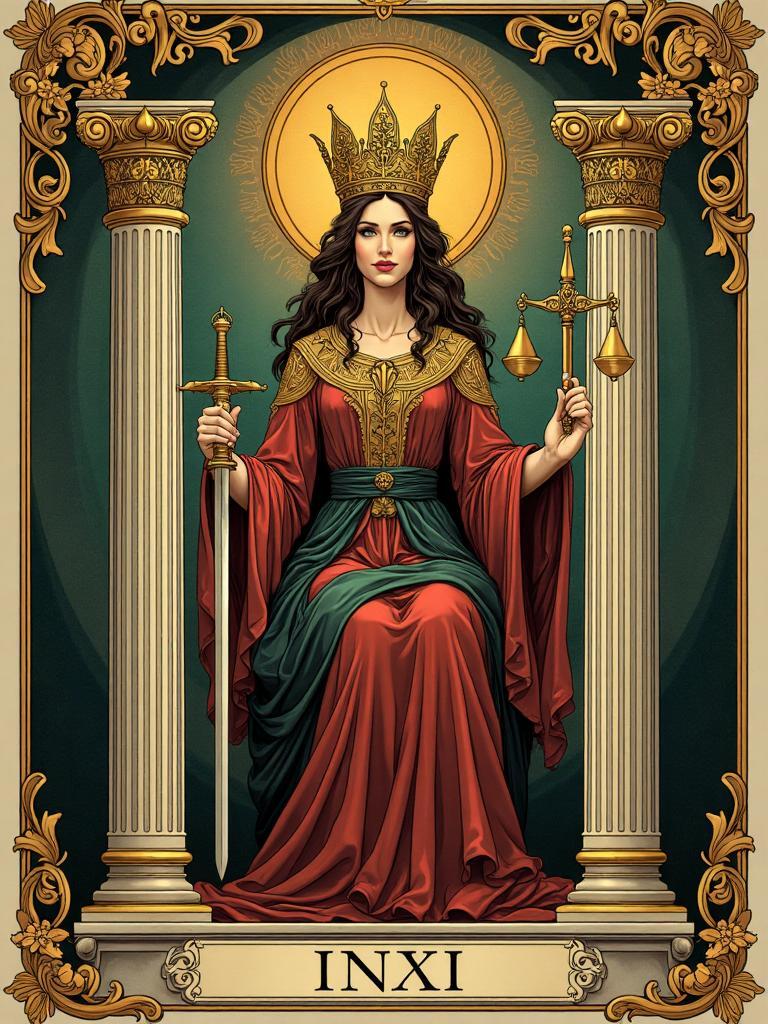
Justice – Tarot Card Meaning
Explore the psychological depth of the Justice Tarot card. Learn about accountability, objective truth, and the balance between logic and emotion.
Core meaning
Justice represents the principle of cause and effect, objectivity, and the pursuit of truth through rational analysis. It symbolizes the necessity of taking full responsibility for one's actions and finding an equilibrium between emotional impulses and logical consequences.
Justice upright meaning
Justice and balance are called for. This card calls for honesty and taking responsibility. Decisions should be made fairly.
Universal law operates with perfect precision. Align your actions with truth and fairness.
The scales of truth weigh all actions. Integrity in this moment creates a foundation for the future.
Justice reversed meaning
Injustice or dishonesty. Check whether you or others are acting fairly.
Accountability has been avoided. The reckoning may be delayed but not denied.
The scales are unbalanced. Examine where truth has been compromised.
Justice in love
Fairness and balance in the relationship. Honest communication is essential.
Truth-telling, though difficult, strengthens authentic connection.
Justice in career and finances
Legal matters or fair negotiations. Honesty pays off.
Career decisions should honor ethical considerations. The right choice is the wise choice.
Justice spiritual meaning
Karma and cosmic justice. Take responsibility for your actions.
Spiritual accountability is a path to freedom. Embrace truth as your ally.
The card's advice
Act with integrity and strive for balance. The truth will come to light.
Own your actions and their consequences. Honest accounting brings liberation.
Justice: yes or no?
Maybe. In a yes/no question, Justice gives no clear signal: the answer depends on your next step.
Reflection
Psychologically, Justice embodies the archetype of the 'Internal Judge' and the cognitive drive for integrity and consistency. It invites the individual to transcend personal biases and emotional distortions to perceive reality with clinical clarity. This card reflects the process of self-evaluation where we must weigh our choices and their long-term impact without falling into the trap of self-deception. It represents the psychological integration of accountability, suggesting that true inner peace is only possible when our external actions align with our internal values.
Typical questions
- To what extent am I being truly honest with myself about my contribution to this situation?
- What objective facts am I currently ignoring because they are emotionally uncomfortable?
- How would a neutral, third-party observer evaluate my recent decisions and behavior?
- Where in my life is the balance between my needs and my responsibilities currently disturbed?
- What logical consequences of my past actions am I currently experiencing, and how can I integrate them?
What it does not mean
Justice is not a symbol of 'divine punishment' or a magical promise of a favorable outcome in legal matters. It does not represent a moralistic or rigid dogma, but rather the functional clarity of cause and effect in a psychological context. It should not be misinterpreted as a sign of external fate intervening, as its focus remains strictly on personal agency and rational accountability.
Justice symbolism: what the card shows
Justice is card XI in the classic Rider-Waite-Smith deck, illustrated by Pamela Colman Smith in 1909. A crowned figure in a red robe sits on a throne between two grey pillars, with a purple veil hanging behind. In the right hand a double-edged sword points straight up; the left hand holds a pair of scales. The figure looks directly at you.
Unlike the familiar statue of Lady Justice in front of many courthouses, this figure wears no blindfold. Justice here is not blind; it sees the facts clearly and asks you to do the same. The scales weigh what has happened, and the sword turns that weighing into a decision. Because the blade is double-edged, it cuts both ways: every decision has consequences for everyone involved, including the person who makes it. The pillars recall those of The High Priestess, yet the mood is very different. Where she guards a mystery, Justice sits in the open and asks for an honest account.
Justice reversed in love
Reversed, Justice in love often shows a relationship that has tipped out of balance. One partner may carry most of the household, the planning or the emotional work, while the other hardly notices. Couples sometimes slip into keeping score: who apologised last, who paid for what, who gave up more. Secrets and half-truths can belong here too, such as an unmentioned debt or contact with an ex that is downplayed. Little by little they erode the trust the relationship depends on.
For singles, the reversed card may point to an old relationship that still feels unresolved, with blame that has not settled, or to judging new people by a strict checklist rather than by who they are. The card asks for an honest look at your own part as well as theirs. A useful first step is to name one thing that feels unfair and say it calmly. For the upright meaning, see Justice in love.
Justice as feelings
If Justice comes up for "what do they feel for me?", the feelings are likely considered rather than impulsive. The person may respect you deeply and want the connection to be fair and honest on both sides. They might be weighing things up: what they can offer, whether the timing works, whether their feelings match their commitments. This can look cool from the outside, but it often means they take you seriously.
Reversed, the scales may be heavy with resentment or guilt. The person might feel treated unfairly, or know that they have not been fully honest with you. Read this as a tendency to reflect on, not as a judgement of anyone. A frank, respectful conversation is the only fair way to learn where they really stand.
Justice: yes or no?
Maybe – Justice does not lean either way on its own. It weighs. The answer depends on the facts of your situation and on whether the outcome you want is fair to everyone involved. That makes it ideal for questions like "Should I sign this contract?" or "Is it right to ask for a raise now?", where the card asks you to check the small print and your own motives first. Reversed, the maybe turns more cautious: something relevant is not yet on the table. You can try the yes or no tarot for your own question.
Justice as your card of the day
As your card of the day, Justice asks you to settle accounts, literally or figuratively. Look for loose ends: an email you have been avoiding, money you owe a friend, a promise you made and have not kept. It is also a good day for fair, clear conversations, as long as you listen as carefully as you speak. One practical step: choose one open matter and close it before evening. You will probably feel lighter afterwards. When you want the next card, the daily card is free to draw again tomorrow.
Justice as a person
Justice as a person is principled and clear-headed. They read the small print, notice when something is unfair and will speak up even when it costs them. Friends ask them for an honest opinion because they know they will get one, and they often make good mediators because they can see both sides. The shadow side is rigidity. They may judge too quickly, treat feelings as less important than facts, or hold others, and themselves, to standards no one can meet. When the card describes you, it asks whether you leave room for mercy inside your sense of fairness.
Justice for health and wellbeing
For wellbeing, Justice is about balance and honest bookkeeping. How much do you give out in work and care for others, and how much rest do you take in return? The card invites you to look at your habits without judgement, as cause and effect: late nights lead to tired mornings, regular meals to steadier energy. Small, fair adjustments usually work better than strict rules. This is meant for reflection and is not medical advice; if a health matter troubles you, the right person to ask is a doctor.
Justice as your year card
A Justice year often brings decisions with lasting consequences, such as contracts, agreements or commitments, and asks you to make them carefully and honestly. It can also bring clarity about past choices. To calculate your year card, add your day and month of birth to the year, then reduce the digits until you have 22 or less; 22 means The Fool (0). Born on 9 September? 9 + 9 + 2027 = 2045 → 2 + 0 + 4 + 5 = 11, Justice. Fittingly, 2027 itself is a Justice year for everyone, since 2 + 0 + 2 + 7 = 11.
Justice affirmation
"I look honestly at my choices and take ownership of what they bring."
"I can be fair to others without being unfair to myself."
Justice: frequently asked questions
Does Justice mean I will win my court case?
This is one of the most common questions about the card. Justice reflects fairness, truth and cause and effect, but it does not predict the outcome of a legal matter. It invites you to prepare carefully, be honest about the facts and seek proper legal advice. If you are in a dispute, the card asks what a fair resolution would look like, which is often a better guide than hoping to win.
What is the difference between Justice and Judgement?
The two names sound alike, which causes confusion. Justice is about weighing facts and taking responsibility for a decision. Judgement, card XX, is about awakening and a call to a new stage of life, a moment of inner renewal more than a verdict. In a reading together, they can suggest that an honest reckoning with the past opens the way to a fresh start.
What does Justice reversed mean at work?
At work, the reversed card often points to unfair treatment or unclear rules: credit taken for your work, a promotion decided on favouritism, or an agreement that was never put in writing. It can also ask whether you have cut corners yourself. The card invites you to document facts and address the issue through fair channels. For the upright career meaning, see Justice in your career.