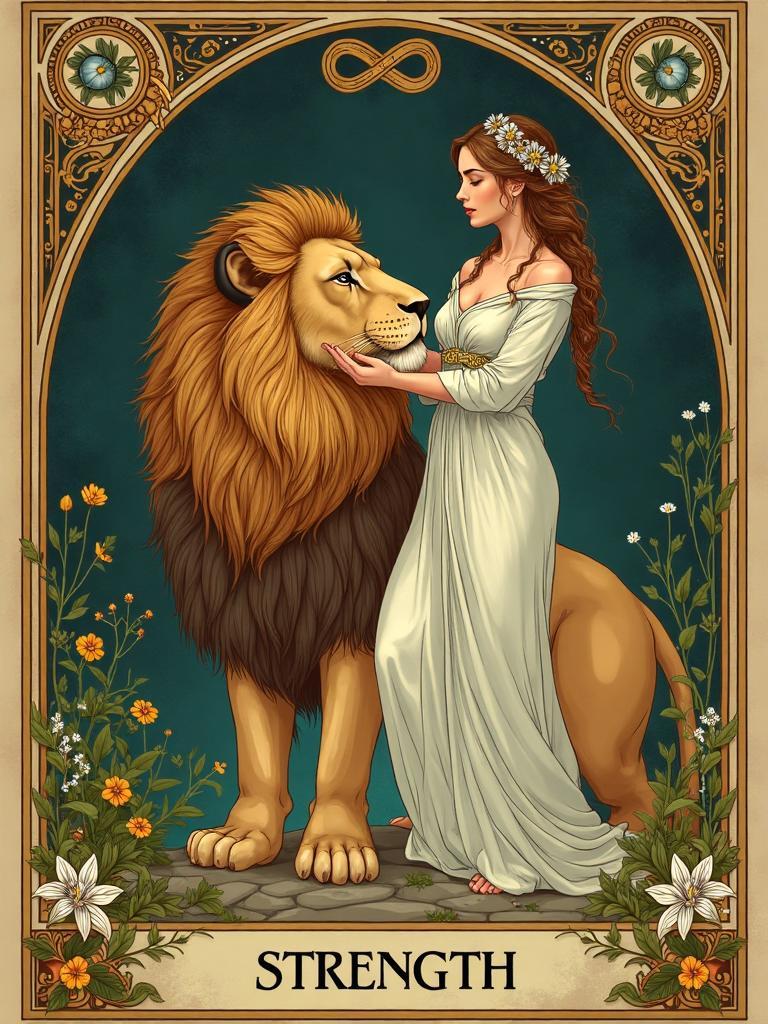
Strength – Tarot Card Meaning
Explore the psychological depth of the Strength Tarot card. Learn about inner resilience, shadow integration, and the power of compassionate self-mastery.
Core meaning
Strength represents the inner courage and resilience required to face life's challenges with compassion rather than brute force. It symbolizes the harmonious integration of primitive instincts with conscious awareness, leading to a state of calm authority and self-mastery.
Strength upright meaning
True strength comes from within. This card shows that gentleness and patience are more powerful than brute force.
Inner power radiates with quiet confidence. You are stronger than you know, especially when you act with heart.
The lion lies down with the lamb when approached with love. Courage and compassion unite to overcome all challenges.
Strength reversed meaning
Self-doubt or suppressed emotions. Acknowledge your inner power.
Raw emotion overwhelms refined power. Find the balance between passion and control.
Fear masks your innate strength. Reconnect with the courage that lives in your heart.
Strength in love
Patience and understanding in the relationship. Gentle strength works wonders.
Relationship challenges yield to gentle persistence. Let love be stronger than fear.
Strength in career and finances
Perseverance leads to success. Stay calm under pressure.
Your quiet confidence inspires others. Lead with steady, patient power.
Strength spiritual meaning
Mastery of your own nature. Courage to face inner shadows.
The path of the heart requires courage. Face your fears with gentle determination.
The card's advice
Meet challenges with gentleness and perseverance. Inner strength carries you.
Trust in your quiet power. Steady, loving persistence achieves what force cannot.
Strength: yes or no?
Yes. In a yes/no question, Strength stands for yes: the card's energy supports what you have in mind.
Reflection
Psychologically, this card speaks to the integration of the 'inner beast'—our raw impulses, fears, and shadow aspects. Instead of suppressing these primal energies, Strength invites us to befriend them through radical self-acceptance and emotional intelligence. This process reflects the growth potential found in vulnerability, suggesting that true power arises when we stop fighting ourselves and start nurturing our internal landscape. It highlights the archetypal journey of taming one's ego through patience and the quiet endurance of the human spirit.
Typical questions
- How can I approach my current challenges with gentleness rather than aggression?
- Which 'inner beast' or shadow aspect of myself am I currently trying to suppress or ignore?
- In what areas of my life is quiet patience a more effective tool than immediate action?
- How can I better integrate my primitive instincts with my higher rational goals?
- What does true inner resilience and emotional sovereignty look like for me right now?
What it does not mean
Strength is not about physical dominance, aggressive willpower, or 'winning' at the expense of others. It should not be misinterpreted as a call to simply 'tough it out' or suppress one's emotions in favor of a stoic facade. Furthermore, it is not a prediction of external victory, but rather an invitation to develop the internal character necessary to handle whatever outcome arises.
Strength symbolism: what the card shows
In the classic Rider-Waite-Smith deck, published in 1909 with images by Pamela Colman Smith, Strength carries the number VIII. A woman in a simple white robe bends over a lion, her hands resting calmly on its jaws. A garland of flowers circles her waist and crowns her hair, and above her head floats the infinity sign, the horizontal figure eight. Behind them the landscape is open, with a mountain in the distance.
Every detail argues against force. The woman wears no armour, unlike the charioteer on the card before her, and she holds no weapon. The lion stands for raw instinct: anger, desire, fear, the urge to fight or flee. She does not defeat it; she befriends it, and the lion lets her. The chain of flowers suggests that what binds the two is gentleness rather than iron. The infinity sign, which also appears above The Magician, points to a power that renews itself instead of running out, the kind of patience that can be practised again tomorrow.
Strength reversed in love
Reversed, Strength in love often means that feelings are either swallowed or let loose without care. In a relationship, one partner may keep the peace by swallowing every irritation until a small thing, like dishes left in the sink, sets off an argument out of all proportion. Or jealousy and insecurity start running the show, and every late reply turns into a test of loyalty. Sometimes patience itself has gone wrong: you have been understanding for so long that you no longer say what you need.
For singles, the reversed card frequently points to self-doubt. You might hide your real personality on dates, assume you are "too much" or "not enough", or rush into strong chemistry to drown out the fear of being alone. The card asks you to treat your own wild side kindly and bring it into the open. You can read the upright meaning in Strength in love.
Strength as feelings
Asked "what does this person feel for me?", Strength tends to describe tenderness with depth behind it. The person may feel protective of you and genuinely patient, willing to give the connection time instead of pushing for quick answers. There is often passion underneath, but it is held with care, which can make them seem calmer than they actually feel. They may admire how you handle difficult moments, or feel safe enough with you to show a softer side.
Reversed, the same depth can turn into insecurity. The person might doubt whether they are good enough for you, or find their feelings stronger than they know how to handle and react by pulling back or overreacting. Treat this as a pattern worth noticing, never as a reading of their mind; the reliable answer comes from asking them.
Strength: yes or no?
Yes – Strength says yes, though it is the yes of a long breath rather than a quick win. It fits questions where your stamina and calm matter more than speed: "Can I handle this new responsibility?", "Should I keep going with this course?" or "Should I raise this sensitive topic with my partner?" Reversed, the answer stays yes, but the card advises you not to force it; build your confidence first and the result will follow more easily. Try your own question with the yes or no tarot.
Strength as your card of the day
With Strength as your card for the day, expect a moment that tests your temper or your nerve. A colleague's sharp remark, a slow queue, a phone call you have been dreading. The card does not ask you to be fearless; it asks you to stay friendly with your own reactions. Here is a small practice: when irritation rises today, breathe out slowly and wait ten seconds before you reply. Then notice how differently the conversation goes. And if there is one thing you have been avoiding out of nervousness, do the first small part of it. The daily card has a new card for you tomorrow.
Strength as a person
Strength as a person describes someone with quiet authority. They stay calm when others panic, speak softly and are still taken seriously, and have a gift for handling difficult people without humiliating them. Children, animals and nervous colleagues often relax around them. Their strength lies in emotional intelligence and patience that does not have to prove anything. The shadow side is over-tolerance. They may put up with too much for too long, hide their own needs behind understanding, or take a secret pride in never losing their temper. When the card describes you, it asks whether your gentleness includes gentleness towards yourself.
Strength for health and wellbeing
Strength favours steady habits over dramatic fixes when it comes to wellbeing. It invites you to build resilience slowly: a regular walk, enough sleep, meals that are not rushed. It also asks how you treat yourself when energy is low. Pushing harder rarely works; kind, consistent attention usually does. Notice where you carry tension during stressful days, and give that part of you a pause. These are suggestions for reflection only, and the card does not replace medical advice; if a health question is on your mind, please talk to a doctor.
Strength as your year card
A Strength year tends to test and build your confidence. Situations may ask for patience you did not know you had, such as a long project, a family matter that needs calm, or a personal habit you are finally changing. The reward is a deeper trust in yourself. Here is how to calculate your year card: add your day and month of birth to the year and keep adding the digits of the result until the number is 22 or lower; 22 stands for The Fool (0). Born on 21 December? 21 + 12 + 2027 = 2060 → 2 + 0 + 6 + 0 = 8, Strength.
Strength affirmation
"I can stay gentle and still hold my ground."
"My courage grows each time I meet my fear with patience."
Strength: frequently asked questions
Why is Strength number VIII in some decks and XI in others?
In the older Tarot de Marseille, Strength is card XI and Justice is VIII. Arthur Edward Waite swapped the two when he designed the Rider-Waite-Smith deck, to match the astrological order of the Hermetic Order of the Golden Dawn, which links Strength with Leo and Justice with Libra. That is why you will find both numbers in books and online. The meaning of the card is the same either way; on this site, Strength follows the Rider-Waite-Smith order as VIII.
Is Strength reversed a sign of weakness?
Not really. The reversed card rarely describes a lack of strength; it describes strength that is blocked or misdirected. Courage may be hidden behind self-doubt, or a powerful emotion may be leading instead of being guided. The card invites you to notice where you have stopped trusting yourself and to reconnect with that quieter confidence. It is a call to find your footing, not a judgement of who you are.
What does Strength mean together with The Tower?
The Tower describes a sudden shake-up, and Strength describes the calm needed to get through it. Together they often suggest that something around you is changing fast, while the real resource lies in how steadily you respond. The pairing invites you to accept what cannot be held and to protect what matters most. In a choice, Strength in decisions explains how gentleness can guide the next step.