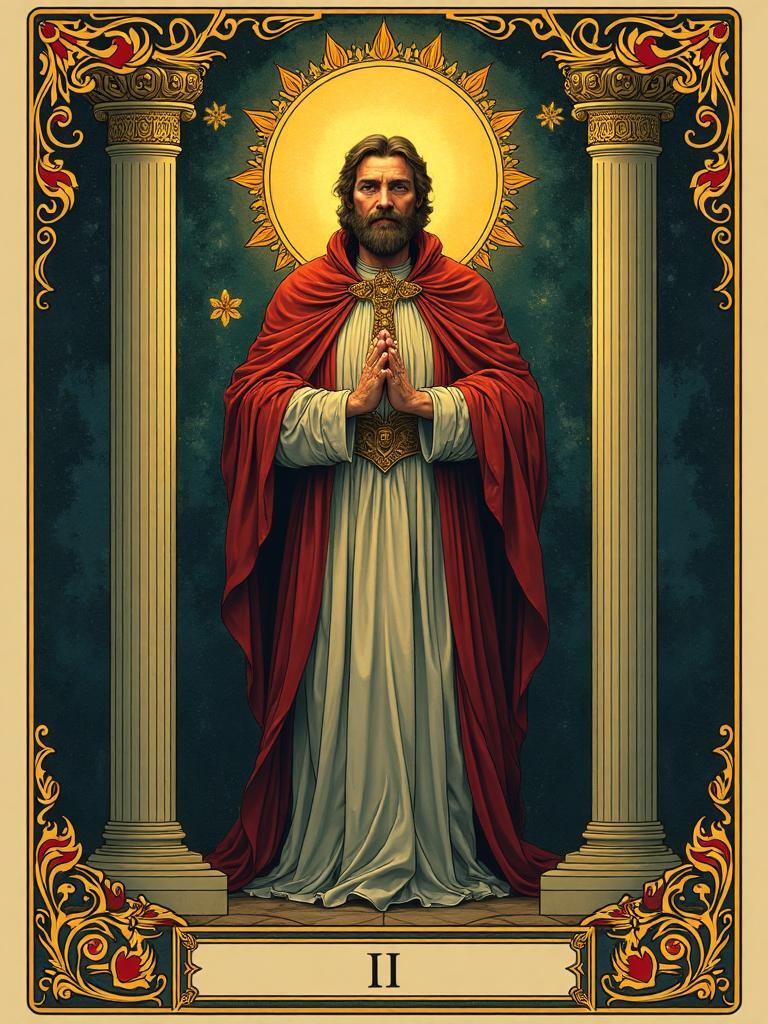
The Hierophant – Tarot Card Meaning
Explore The Hierophant's psychological depth: tradition, social structures, and the search for meaning through collective wisdom and ethical frameworks.
Core meaning
The Hierophant represents the search for meaning through established traditions, structured belief systems, and social institutions. It embodies the bridge between individual experience and collective wisdom, emphasizing the importance of ritual and shared ethical frameworks.
The Hierophant upright meaning
Traditional values and inherited wisdom can provide guidance now. The Hierophant points to teachers, mentors, or spiritual guidance.
The bridge between human and divine is built on tradition. Honor the teachings that have stood the test of time.
Ancient wisdom speaks through established channels. Seek those who have walked the path before you.
The Hierophant reversed meaning
Questioning traditions or searching for your own path. Not all rules fit for you.
The established path feels confining. Perhaps it's time to forge your own spiritual tradition.
Conventional wisdom may not serve your unique journey. Trust your inner authority.
The Hierophant in love
Traditional values in the relationship. Possibly marriage or official commitment.
Shared values and beliefs unite partners. Explore your common spiritual or cultural ground.
The Hierophant in career and finances
Established paths to success. Further training or mentoring could be helpful.
Professional credentials and formal education open doors. Follow established protocols.
The Hierophant spiritual meaning
Study of spiritual traditions. A teacher or community could be important.
The divine speaks through tradition. Find your place within the lineage of seekers.
The card's advice
Look for proven methods or trustworthy advisors. Tradition has value.
Sometimes the well-worn path is best. Honor what has worked for generations.
The Hierophant: yes or no?
Maybe. In a yes/no question, The Hierophant gives no clear signal: the answer depends on your next step.
Reflection
Psychologically, this card relates to the Superego and the internalization of societal norms and cultural values. It invites an exploration of the 'Wise Teacher' archetype, reflecting how we integrate external guidance into our personal identity and sense of morality. The Hierophant asks us to examine our relationship with authority and the structures that provide us with a sense of belonging. It highlights the growth potential found in discipline and the study of formal knowledge, while also prompting a reflection on the tension between individual belief and collective dogma.
Typical questions
- In which areas of my life am I currently seeking structure or formal guidance?
- To what extent do I follow traditions out of genuine conviction versus mere social pressure?
- Who are the mentors or institutions that currently shape my worldview, and is their influence still healthy?
- How can I balance my need for individual expression with my desire for collective belonging?
- What rituals or routines currently give my life a sense of sacredness or purpose?
What it does not mean
This card is not a prediction of a literal religious ceremony or a 'sign' that one must join a specific organization. It should not be misinterpreted as a mandate for blind obedience or a promise that an external authority will solve one's internal conflicts. Rather than predicting a future event, it focuses on the internal psychological structures of belief and the value of systematic learning.
The Hierophant symbolism: what the card shows
Card V moves the scene from private to public. In the classic Rider-Waite-Smith deck, Pamela Colman Smith drew The Hierophant in 1909 as a religious teacher in red robes and a triple crown, seated between two grey pillars. His right hand is raised in blessing, his left holds a staff topped with a triple cross, and two crossed keys lie at his feet. Before him kneel two tonsured followers, one with roses on his robe and one with lilies.
The two pillars recall those of The High Priestess, but here the hidden knowledge has become a shared teaching, passed on in a recognised setting. The crossed keys stand for access: to learning, to a community, to the meaning behind its rituals. The blessing hand speaks of approval and belonging, while the triple crown and cross are often read as levels of understanding. The two kneeling figures show that this card is always about a relationship between teacher and student. Every tradition lives only as long as someone is willing to learn it, and later to question it.
The Hierophant reversed in love
Reversed, The Hierophant in love often questions rules you never chose. In a couple, these can be family expectations about when to marry, where to live or how to raise children, or two different traditions colliding over holidays, religion or the wedding itself. The card can also show a relationship run on the idea of how things "should" be, while neither partner checks whether that script still fits.
For singles, the reversed card might describe dating by an inherited checklist: the right age, the right job, the right background. Or it can show the opposite reaction, rejecting anyone who seems too conventional just to prove you are different. In both cases, the card asks which values are truly yours. A good next step is to write down three things you want in a relationship without asking what anyone else would think. The upright view is in The Hierophant in love.
The Hierophant as feelings
Drawn for "how does this person feel about me?", The Hierophant suggests that they take you seriously. Their feelings are likely tied to values: respect, loyalty and the wish to do things properly. They may want to introduce you to family or friends, think in terms of long-term commitment, and move at a steady, perhaps traditional pace. Big impulsive gestures are less likely than quiet reliability.
Reversed, the card may show someone torn between what they feel and what is expected of them, perhaps by family, culture or their own beliefs. They might care for you and still hesitate. Treat this as a tendency to reflect on rather than a fact about another person; their own words are the only clear answer.
The Hierophant: yes or no?
Maybe. The Hierophant's answer depends on whether the plan fits the framework around it. If you follow proven steps, ask the right people and respect the rules that apply, the outlook improves; if you hope to skip them, it weakens. The card answers questions about formal steps well: "Should I enrol in this course?", "Should I apply through the official route?", "Should we have a traditional wedding?" Reversed, the maybe holds, but the question shifts to whose rules you are following. You can ask a question of your own in the yes or no tarot.
The Hierophant as your card of the day
As your card of the day, The Hierophant suggests learning from someone who has walked the path before you. Watch for advice, instructions or traditions you usually skip. A practical step: ask one experienced person a specific question today, or read the manual, the contract or the guidelines properly before you start. You might also notice the small rituals that hold your day together, such as morning coffee or a walk after work, and choose one to do with full attention. A new message waits tomorrow in the daily tarot card.
The Hierophant as a person
As a person, The Hierophant describes a mentor, teacher or keeper of knowledge. They are principled, patient and good at explaining how things work and why they are done a certain way. You might find them leading a choir, training new colleagues or holding a family's traditions together. Their strengths are reliability, a sense of duty and the ability to give others a framework to grow in. The shadow side is dogmatism: they may judge those who choose differently, cling to "how it has always been done" or confuse rules with values. If this card describes you, it asks which of your convictions you have actually examined.
The Hierophant for health and wellbeing
For wellbeing, The Hierophant values tried-and-tested routines and good guidance. It can point to the support of a group, such as a yoga class, a walking club or a regular community activity, where structure and company help you stay consistent. The card also favours trusted, qualified advice over the latest trend you saw online. In that spirit: the card is a tool for reflection, and questions about your health belong with a doctor.
The Hierophant as your year card
To find your personal year card, add the day and month of your birth to the year, then add the digits of the result until it is 22 or less; 22 stands for The Fool (0). For someone born on 2 January, that gives 2 + 1 + 2027 = 2030 → 2 + 0 + 3 + 0 = 5, The Hierophant. A year under this card often brings learning in a formal setting, such as training, a qualification or an apprenticeship. It can also bring commitments that are made official, membership in a community, or the chance to become a mentor yourself. Expect a year that rewards patience, study and respect for well-tested methods.
The Hierophant affirmation
"I learn from those who came before me and keep what is true for me."
"My values guide me, even when they differ from the rules around me."
The Hierophant: frequently asked questions
Does The Hierophant mean marriage?
Many people ask this because the card is linked to commitment and ceremony. It does not predict a wedding. It reflects a phase in which questions of commitment, shared values and official recognition become important. That can mean talking about marriage, but it can also mean deciding together what commitment means to both of you, with or without a ceremony.
What does The Hierophant mean with The Lovers?
These neighbouring cards bring together tradition and personal choice. The Lovers is about choosing from the heart, while The Hierophant represents the framework around that choice. Together they can point to a commitment that is both chosen and formalised, such as an engagement. They can also reveal tension, for example when family expectations and your own feelings pull in different directions.
Is The Hierophant a good card for exams or studies?
For learning, it is one of the most supportive cards in the deck. It favours structured study, good teachers and following the syllabus rather than improvising. For exams, it suggests sticking to proven methods and asking for help where you are unsure. Reversed, it can show frustration with rigid systems or a wish to learn in your own way. More about this in The Hierophant in career readings.