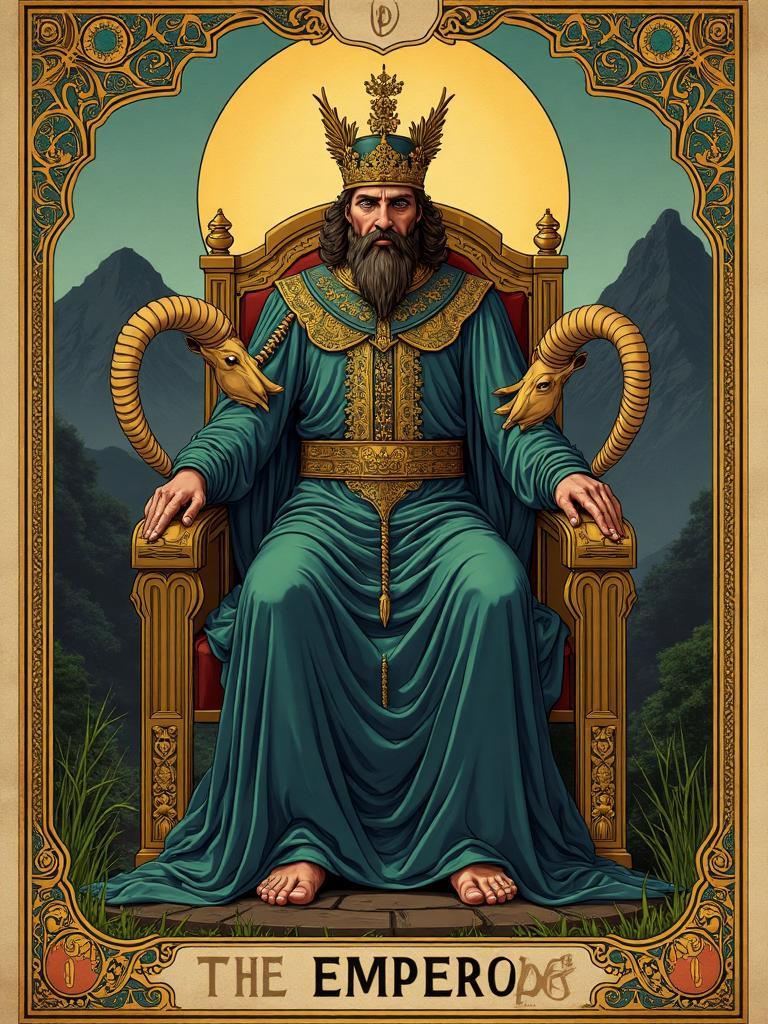
The Emperor – Tarot Card Meaning
Discover the psychological depth of The Emperor Tarot card. Learn about structure, inner authority, and the father archetype for personal growth.
Core meaning
The Emperor represents the principles of structure, stability, and the establishment of order through authority and discipline. He symbolizes the capacity to manifest vision into reality by creating a solid foundation and clear boundaries.
The Emperor upright meaning
Structure and stability are important now. The Emperor calls you to take responsibility and set clear boundaries.
Authority flows from inner mastery. Lead with wisdom, and others will follow your example.
Build your kingdom on foundations of order and discipline. Strong structures support great achievements.
The Emperor reversed meaning
Excessive control or lack of structure. Find the balance between leadership and flexibility.
Power wielded without wisdom creates chaos. Examine whether you govern too harshly or too loosely.
The throne of control may have become a prison. Loosen your grip or establish needed order.
The Emperor in love
Stability and reliability in the relationship. Clear communication is important.
Take responsibility for your role in relationships. Commitment and consistency strengthen bonds.
The Emperor in career and finances
Leadership qualities are in demand. Set clear goals and pursue them consistently.
Career success comes through discipline and strategic planning. Build your professional empire.
The Emperor spiritual meaning
Bring order to your spiritual practice. Discipline supports your growth.
Master the material realm to transcend it. Earthly discipline serves spiritual evolution.
The card's advice
Take responsibility and act with determination. Structure brings security.
Step into your authority with confidence. Lead by example and build lasting foundations.
The Emperor: yes or no?
Yes. In a yes/no question, The Emperor stands for yes: the card's energy supports what you have in mind.
Reflection
Archetypally, the Emperor embodies the 'Father' principle and the 'Animus,' focusing on our relationship with power and external systems. Psychologically, this card invites us to examine how we regulate our internal world and whether our need for control provides security or leads to rigid stagnation. It reflects the growth potential found in taking responsibility for one's life and the ethical exercise of influence. True empowerment in this context means mastering self-discipline rather than dominating others, highlighting the balance between protection and oppression.
Typical questions
- Where in my life do I need more structure and discipline to achieve my long-term goals?
- What is my current relationship with authority, and how does it influence my own sense of agency?
- Am I using my personal power to build a supportive framework or to rigidly control my environment?
- How can I establish healthier boundaries to protect my energy and values?
- In what areas of my life am I avoiding the responsibility of leadership or self-governance?
What it does not mean
The Emperor does not predict an encounter with a powerful person or guarantee professional success through luck. It is not a sign of inevitable victory, nor should it be interpreted as an endorsement of tyranny or inflexible dogmatism. Instead of external fortune-telling, it focuses on the psychological necessity of internal order and the maturation of one's own sense of authority.
The Emperor symbolism: what the card shows
Stone, armour and bare rock set the tone of card IV. In the classic Rider-Waite-Smith deck, drawn by Pamela Colman Smith in 1909, The Emperor sits on a massive stone throne whose corners are carved with rams' heads. He has a long white beard and wears a red robe, with armour visible beneath it. In his right hand he holds a sceptre topped with an ankh, in his left an orb, and behind him rise steep, barren mountains.
Each detail adds to a picture of lasting order. The stone throne is built to last, not to be comfortable. The rams link the card to Aries and its drive to lead and to begin. The ankh, an Egyptian symbol of life, suggests that his authority exists to protect life, while the orb stands for the world he is responsible for. The armour under the robe shows someone ready to defend what he has built, even in times of peace. The bare mountains show achievement in hard terrain, where little grows without effort and planning.
The Emperor reversed in love
Reversed, The Emperor in love often describes control showing up where reliability is needed. In a relationship, that can look like one partner deciding the budget, the holidays and the social calendar, while the other has stopped offering opinions. It can also appear as jealousy framed as protection, or as rules about how the other person should dress, spend or behave. Sometimes the card shows the opposite gap: nobody takes responsibility, bills are paid late, plans are never made, and both of you wait for the other to lead.
For singles, the reversed card might describe a rigid checklist that rules people out before you have met them, or a pattern of falling for partners who take charge of everything and then feel suffocating. The card invites you to look for strength that makes room for you rather than over you. The upright side of his love story is told in The Emperor in love and relationships.
The Emperor as feelings
If The Emperor appears when you ask "what are their feelings for me?", it usually points to serious, steady intentions. The person may feel protective of you and want to offer something solid: a plan, a commitment, a clear place in their life. They often show feelings through actions rather than words, fixing what is broken, keeping promises, sorting out the practical side. Romantic speeches may be rare, but reliability is high.
Reversed, the card can hint that the person wants control more than closeness, or that they hide their emotions behind duty and rarely let you see what they feel. As with any card drawn for another person, take this as a tendency to reflect on; what someone really feels is theirs to tell you.
The Emperor: yes or no?
Yes. The Emperor gives a firm yes, as long as there is a plan behind it. He answers structured questions well: "Should I sign the contract?", "Is it time to make our relationship official?", "Should I take on the leadership role?" His yes rewards preparation, clear agreements and follow-through. Reversed, the answer stays yes, but he asks whether you are clinging too tightly to control or following a plan that someone else wrote for you. You can test your own question with a single card in the yes or no tarot.
The Emperor as your card of the day
As your card of the day, The Emperor asks you to bring order to one area that has been drifting. Watch for moments today when a clear boundary or a firm decision would save everyone time. A practical step: block out a fixed hour for the task you keep postponing, and protect it as you would an appointment with someone important. If something needs a definite "no", say it calmly and without long explanations. When you want guidance for another day, draw again with the daily card.
The Emperor as a person
As a person, The Emperor describes someone dependable, organised and protective, the kind of person others turn to in a crisis because they stay calm and make decisions. They keep their word, take responsibility and like clear structures, whether they run a team, a household or a sports club. Their strengths are leadership, loyalty and the ability to turn chaos into a workable plan. The shadow side is rigidity: they may struggle to delegate, dismiss feelings as inefficient, or confuse authority with always being right. When this card stands for you, it asks whether your structures still serve the people inside them, including yourself.
The Emperor for health and wellbeing
For wellbeing, The Emperor favours structure: regular sleep times, planned meals and a routine you can keep even on busy weeks. Discipline can be a great support here. The card also notes the cost of wearing armour all day, since constant self-control can show up as tension, a stiff neck or difficulty switching off in the evening. Make rest part of the plan rather than a reward you have to earn. This is a card for reflection only, and anything that concerns your health should be discussed with a doctor.
The Emperor as your year card
To calculate a personal year card, add your day and month of birth to the year and keep adding the digits of the result until you reach a number of 22 or less; 22 stands for The Fool (0). In 2027 every result lands between 5 and 17, so The Emperor is not anyone's calculated year card that year, although he can still turn up when you draw a card for the year ahead. A year with The Emperor tends to be about building foundations: a promotion with more responsibility, a property, a business set up properly, or simply clearer rules for your own time. It asks for commitment and rewards consistency more than inspiration.
The Emperor affirmation
"I build structures that protect what matters to me."
"I lead with steadiness, and I leave room for others to grow."
The Emperor: frequently asked questions
Does The Emperor stand for my father or a specific man?
People often ask this because the card shows a bearded ruler and is linked to the father archetype. It can sometimes describe an authority figure in your life, of any gender, such as a parent, a boss or a mentor. More often, though, it describes a quality you need or are dealing with: responsibility, structure and boundaries. Ask yourself where that energy is strong in your life, and where it is missing.
What does The Emperor mean with Strength?
The two cards show two kinds of power. The Emperor rules through structure and clear authority, while Strength works through patience, gentleness and inner courage. Together they often suggest that firmness works best when it is calm rather than forceful. In a reading, the pair might point to a leadership situation where a quiet word will achieve more than a strict rule, or to taming your own need for control.
What does The Emperor reversed mean for a decision?
In a decision, the reversed Emperor often shows that the choice is being shaped by control, either your own wish to keep everything in hand or pressure from someone with more power. It can also point to a decision without any plan at all. The card suggests writing out the facts, the responsibilities and the realistic next steps before you commit. For a full look, read The Emperor and decisions.