The Emperor Tarot Decision: Yes or No and Clear Choices
The Emperor tarot in a decision leans towards yes when you plan, take responsibility and set boundaries. Read it upright, reversed and as advice.
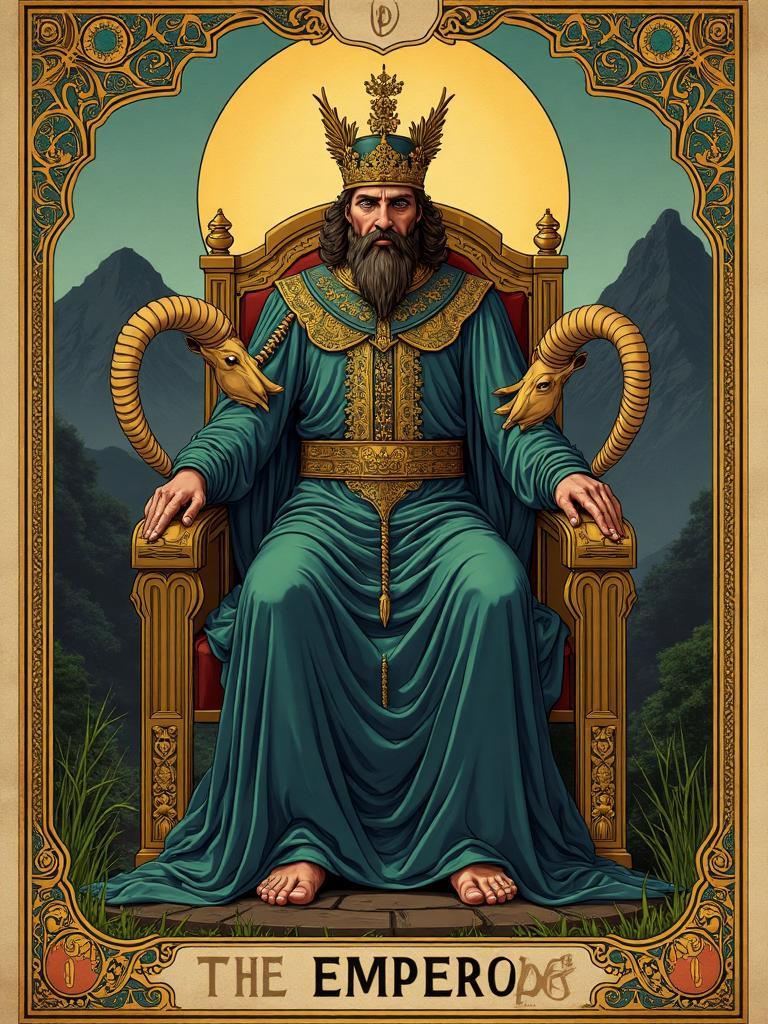
When The Emperor appears in a tarot decision reading, the answer leans towards a structured, deliberate yes. The fourth card of the Major Arcana stands for authority, order and responsibility, and in the context of a choice it asks you to stop drifting, gather the facts and decide like someone who intends to stand behind the result. If you are asking whether to go ahead, The Emperor tarot meaning is clear: choose with structure, or wait until you can.
The Emperor Yes or No: A Conditional Yes
In a yes or no reading, The Emperor is generally a yes. It is not an excited, impulsive yes, though. It is the yes of someone who has studied the plan, checked the foundations and is prepared to take responsibility for the outcome.
The reasoning lies in the card itself. The Emperor sits on a massive stone throne, upright and facing you directly. Behind him rise bare, rocky mountains in shades of orange and red: little grows there, but nothing collapses either. His decisions are built to last. If your question involves commitment, discipline and long-term structure, the card supports moving ahead.
The condition is that you act with a plan. If your yes depends on hoping things will sort themselves out, The Emperor withholds his approval. He says yes to the version of the choice where you are in charge.
Upright in a Decision: Take the Throne
Upright, The Emperor tells you that this decision belongs to you. Nobody else is going to make it on your behalf, and waiting for perfect conditions is just another way of letting things slide. You are the CEO of your own life, and the card asks you to act like it.
Structure before action
Four is the number of stability: four walls, four corners, four legs of a table. In a decision, it points to building a framework before you move. Write down what you actually want, list the realistic options and name the criteria that matter most. A choice made on a clear structure holds up when doubt arrives later.
Responsibility as power
Look at The Emperor's hands. In his right he holds a sceptre topped with an ankh, the Egyptian symbol of life, and in his left a golden orb representing the world he governs. He does not hold either loosely. Upright, the card reminds you that owning a decision, including its risks, is what makes it truly yours. Responsibility can feel heavy, but it also returns your power to you.
Boundaries as part of the choice
Many decisions stall because we try to keep everyone happy. The Emperor knows that every real choice closes some doors. Saying yes to one path means saying no to others, and the card asks you to say that no clearly.
Typical Decision Situations with The Emperor
The Emperor tends to appear when the choice in front of you is about structure, leadership or long-term stability. Common examples include:
- Accepting a promotion or a role in which you will lead other people
- Starting a business or project that needs a solid plan rather than inspiration alone
- Choosing between a stable option and a risky one, especially when others depend on you
- Setting or enforcing a boundary with family, a partner or a colleague
- Committing to a routine, a budget or a training plan after a period of disorder
- Deciding whether to take back control of a situation you have been tolerating
In each case, the card poses the same question: which option allows you to build something stable that you are willing to be responsible for?
The Emperor Reversed in a Decision
The Emperor reversed points to an imbalance in how you are handling control. The throne has either become a prison or been left empty. Both versions distort your decision, and the card asks you to look honestly at which one applies.
Too much control
Reversed, The Emperor can show a choice driven by the need to dominate or to eliminate every uncertainty. Perhaps you are refusing a good option because you would not be fully in charge, or forcing a decision simply to prove that you are. The armour under his red robe, a sign of readiness when upright, turns into rigidity. Ask whether you are deciding from strength or from fear of losing your grip.
Too little structure
The other face of the reversal is chaos. You may be postponing the decision because your life feels too disorganized to choose anything, or you may be letting someone else decide by default. Here the advice is to establish basic order first: clarify facts, deadlines and priorities, and then make the call.
In a yes or no reading, The Emperor reversed leans towards "not yet" or "not in this way". The answer can change once you find the middle ground between micromanaging and letting everything fall apart.
The Emperor's Symbols as a Decision Checklist
The imagery of the card works well as a practical checklist. The four ram heads carved into the throne link The Emperor to Aries, the sign of initiative and decisive action. They ask whether you are ready to begin or simply hesitating out of habit. The red robe stands for drive and vitality, and the steel armour beneath it for the ability to defend a decision once it is made.
The narrow river at the foot of the mountains is easy to miss. It is a reminder that even the strictest structure needs something alive flowing through it. A good Emperor decision is firm, yet it still leaves room for feeling and adjustment. His long white beard speaks of experience: draw on what you have learned from earlier choices rather than starting from zero.
Advice from The Emperor When You Have to Choose
The Emperor's advice is direct: decide, plan and own it. Here is how to apply it.
Write the decision in one sentence. If you cannot state the choice clearly, you are not ready to make it. Clarity is the first act of authority.
Name three concrete next steps. A decision without a plan is only a wish. List what you will do in the first week after choosing.
Check your motives. Ask whether you are choosing the option that builds stability or the one that simply keeps you in control.
Set one boundary. Identify what you will say no to as a result of this choice, and communicate it calmly.
Pick a review date. True leadership is not about controlling everything forever. Decide when you will check whether the new structure still serves you, and adjust it if it does not.
Tarot does not make the decision for you, and The Emperor would be the last card to suggest that it should. What it offers is a mirror: a reminder that you have the strength and judgement to create the structure your life needs right now. Choose with a clear head, take responsibility for the result and build your decision on foundations that will still be standing next year.
Questions for Self-Reflection
- Which part of this decision am I avoiding because it means taking full responsibility?
- What would a clear, written plan for this choice look like?
- Where am I trying to control something that actually needs flexibility?
- Which boundary would make this decision easier to keep?
What This Card Does NOT Mean
- The Emperor does not mean you must decide alone and ignore everyone else's input.
- It does not mean the safest or strictest option is automatically the right one.
- It does not promise a guaranteed outcome just because you made a firm plan.
Typical Life Situations
- Deciding whether to accept a leadership role or a management position
- Choosing whether to commit to a long-term plan such as a move, a degree or a business
- Setting a firm boundary with a family member, partner or colleague
- Deciding how to bring order to your finances or household after a chaotic period
Important Card Combinations
- The Fool: This pair suggests a transition from a period of spontaneous risk-taking into a phase of serious planning and established order.
- The High Priestess: A powerful balance of the 'Divine Masculine' and 'Divine Feminine,' indicating a decision made with both strategic logic and deep intuition.
- The Tower: Indicates that existing structures are failing and you must exert strong leadership to rebuild a more stable foundation from the rubble.
- Justice: A strong sign of legal success or a life path decision that is heavily influenced by ethics, contracts, and objective truth.