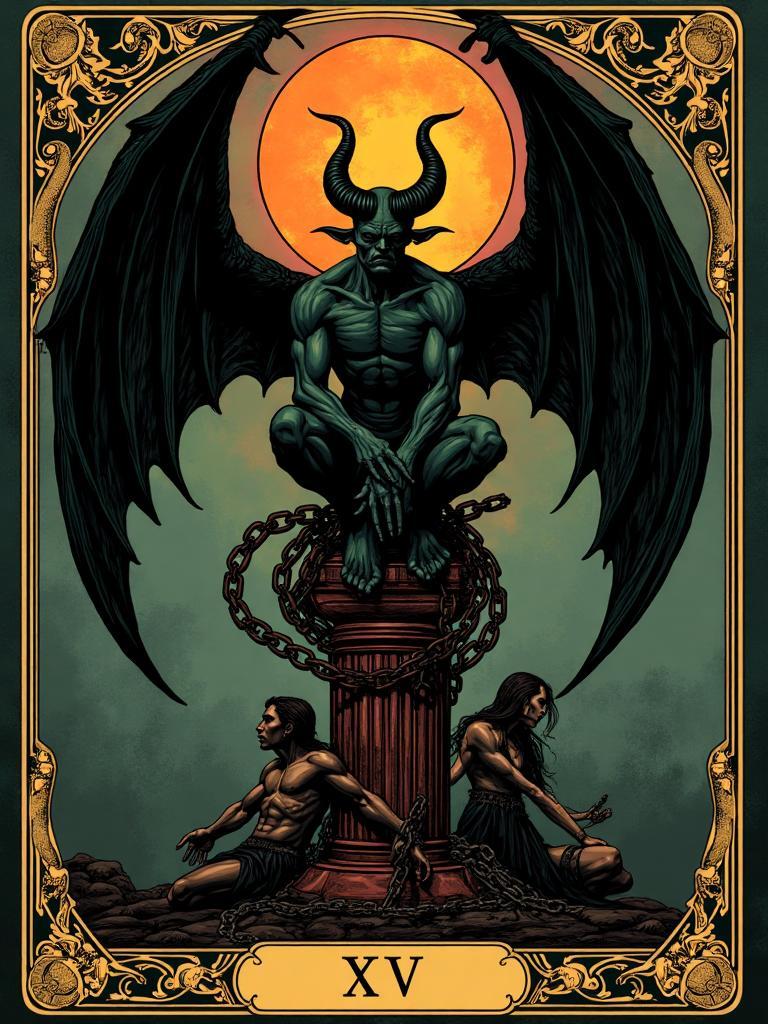
The Devil – Tarot Card Meaning
Explore the psychological depth of The Devil Tarot card. Learn about shadow work, dependencies, and reclaiming personal power through self-reflection.
Core meaning
The Devil represents the psychological experience of bondage, highlighting the self-imposed chains of obsession, dependency, and material fixations. It serves as a confrontation with the shadow self and the primal instincts that can dominate the ego when left unexamined.
The Devil upright meaning
Recognize what binds you. The Devil shows dependencies, addictions, or limiting patterns. Liberation is possible.
Shadow work reveals hidden bonds. Face what controls you to reclaim your power.
The chains appear tight but examine closely—they can be removed. What you believe imprisons you is often an illusion.
The Devil reversed meaning
Liberation from dependencies or denial of inner shadows.
The chains fall away as awareness increases. Freedom comes through honest self-examination.
Breaking free from what once bound you. Or perhaps avoiding the shadow work needed.
The Devil in love
Toxic patterns or intense passion. Check what binds you.
Relationship patterns may be controlling rather than nurturing. Seek honest clarity.
The Devil in career and finances
Work could become a chain. Question material dependencies.
Ambition without soul leads to bondage. Balance material pursuit with meaning.
The Devil spiritual meaning
Confrontation with the shadow. Liberation through awareness.
What you reject in yourself controls you. Integration of shadow brings wholeness.
The card's advice
Question dependencies and take back control. Freedom is possible.
Examine your attachments and addictions. Liberation begins with awareness.
The Devil: yes or no?
No. In a yes/no question, The Devil leans towards no: look at what is holding you back or warning you.
Reflection
In a psychological context, this card embodies the Jungian Shadow—the repressed aspects of our personality that we find difficult to acknowledge. It mirrors the mechanisms of addiction, whether to substances, toxic relationship patterns, or rigid belief systems that limit our autonomy. The loose chains depicted in traditional imagery suggest that our imprisonment is often a matter of perception and habit rather than external reality. By facing these darker impulses, we move from reactive compulsion to conscious self-regulation. This card invites an honest inventory of where we have traded our personal freedom for the illusion of security or immediate gratification.
Typical questions
- In which areas of my life do I feel 'chained' or powerless, and how am I contributing to this dynamic?
- What desires or impulses am I currently suppressing, and how are they manifesting in my behavior?
- Where am I prioritizing material comfort or social status at the expense of my psychological integrity?
- What 'shadow' traits am I projecting onto others instead of acknowledging them within myself?
- How would my life change if I took full responsibility for the habits that currently limit my growth?
What it does not mean
The Devil does not represent literal 'evil,' bad luck, or a malevolent supernatural force intervening in your life. It is not a prediction of doom, but rather a diagnostic tool for identifying internal blockages and unhealthy attachments. Interpretations should avoid moralistic judgment, focusing instead on the neutral observation of psychological patterns and the potential for liberation.
The Devil symbolism: what the card shows
In the classic Rider-Waite-Smith deck, card XV shows a horned figure with bat-like wings crouched on a dark, square block. An inverted pentagram sits on its forehead, its right hand is raised, and its left hand holds a burning torch pointed down towards the ground. Chained to a ring on the block stand a naked man and woman. Both have grown small horns and tails: hers ends in a bunch of grapes, his in a small flame. The chains around their necks hang loose.
Those loose chains are the heart of the card. Nothing in the picture prevents the two figures from lifting them off; they stay because they have stopped noticing they could leave. The grapes and the flame point to appetite and desire, and the horns show how a habit can slowly reshape the person who has it. Many readers also note that the layout echoes The Lovers, card VI, with the angel replaced by this figure: the same two people, but now bound by compulsion instead of a free choice.
The Devil reversed in love
The reversed Devil in a love reading often shows a grip that is starting to loosen. In a relationship, that might be the moment one partner stops checking the other's phone, or the point where both of you admit that jealousy has been running the show. It can also mark the end of an on-off cycle, when you finally see the pattern instead of the person. This is hopeful, but loosening is not the same as being free; old reflexes tend to return under stress.
For singles, the reversed card can describe breaking an attachment to someone who kept you waiting, or recognising that you keep choosing the same type of unavailable partner. Sometimes it also points to the opposite: denying an attraction because it scares you. The card invites honesty about what keeps pulling you back. How the upright card shows up in partnerships is covered in The Devil in love and relationships.
The Devil as feelings
Ask what someone feels for you and draw The Devil, and the card usually speaks of strong attraction with a possessive or obsessive edge. The person may think about you more than they would like, feel drawn to you physically, or find it hard to stay away even when they tell themselves they should. That intensity is real, but it is not necessarily the same as care, trust or a wish to build something together.
Reversed, The Devil can suggest the person is trying to step back from that pull, either because they sense it is not healthy or because they are guarding themselves. Treat this as a theme to reflect on rather than proof of what goes on inside them. What they really feel is theirs to say, and how you feel around them deserves equal attention.
The Devil: yes or no?
No – The Devil advises against the plan, or at least against your reasons for it. If you are asking "Should I text my ex again?" or "Should I take the job just for the money?", the card warns that the choice may come from craving, fear or habit rather than freedom. Reversed, the answer remains no, but the tone changes: you are beginning to see what has been steering you, which is the first step to choosing differently. The card is especially honest on questions of temptation and dependency. You can ask your own question with the yes or no tarot card.
The Devil as your card of the day
As your card of the day, The Devil asks you to watch your autopilot. Notice the moment you reach for your phone without a reason, say yes to an extra shift out of guilt, or buy something you did not plan to. None of these are disasters; they simply show where a habit is in charge. The card is not asking for perfection, only for one moment of awareness. A practical step for today: pick one small automatic habit and delay it by fifteen minutes, then notice how it feels. Draw a fresh card tomorrow with the daily tarot card.
The Devil as a person
As a person, The Devil describes someone with magnetic presence. They are often charismatic, ambitious, sensual and very good at knowing what others want, which makes them persuasive in sales, negotiations or creative fields. They are rarely boring company. The shadow side is control: they may use their charm to bind people, keep score, or encourage dependence because it makes them feel secure. Sometimes this card describes not a manipulator but someone deeply caught in their own patterns, such as overwork, money worries or a need for approval. If it describes you, ask honestly which chain you are holding, and which one you are wearing.
The Devil for health and wellbeing
In wellbeing questions, The Devil puts the spotlight on habits that have become harder to stop than they were to start: late-night snacking, endless scrolling, overtraining, or relying on a drink to switch off. It also touches stress that keeps you hooked on adrenaline. The card does not judge; it simply asks you to look at what you reach for when you are tired or anxious, and what you might reach for instead. If a habit feels out of your control, seeking support is a sign of strength. The card offers reflection, not medical advice, and any real concern about your health or a dependency belongs with a doctor.
The Devil as your year card
A Devil year often brings your attachments into sharp focus. You may notice how much a job, a relationship, money or a habit shapes your choices, and it becomes harder to pretend otherwise. That awareness can be uncomfortable, yet it is what makes real change possible by the end of the year. To find your year card, add your day and month of birth to the year and keep adding the digits of the result until you have 22 or less; 22 is The Fool (0). With a birthday on 26 May, for instance: 26 + 5 + 2027 = 2058 → 2 + 0 + 5 + 8 = 15, The Devil. Use the year to loosen one chain at a time.
The Devil affirmation
"I notice what pulls at me, and I choose where I go."
"The chains I see clearly are the ones I can lift off."
The Devil: frequently asked questions
Does The Devil mean someone is cheating?
It is a common fear when this card turns up in a love reading, but The Devil does not prove infidelity. It speaks about desire, secrecy and patterns of control, which can include temptation but also jealousy, dependency or an imbalance of power. If the card brings this question to mind, it may point to a lack of trust that deserves an open conversation rather than detective work.
What does The Devil mean next to The Lovers?
Because the Rider-Waite-Smith Devil mirrors the layout of The Lovers, the pairing is striking. Together they often describe a strong bond with two sides: genuine love and choice on one hand, attachment and compulsion on the other. The question they raise is whether you are together freely or because leaving feels impossible. In a reading, the pair invites you to look at which side currently shapes the relationship.
Is The Devil reversed a good sign?
Often it is a hopeful one. Reversed, the card can show that a hold is weakening, that you are recognising a pattern and starting to step away from it. It does not mean the work is done; habits can return when life gets stressful. For a decision under this card, see The Devil in decision readings, which explains how to tell freedom from a fresh form of the same chain.