Death Tarot Decision: Yes or No to Endings and New Starts
Death tarot in a decision means yes to change and no to holding on. Learn the yes or no answer, upright and reversed meanings, and how to let go well.
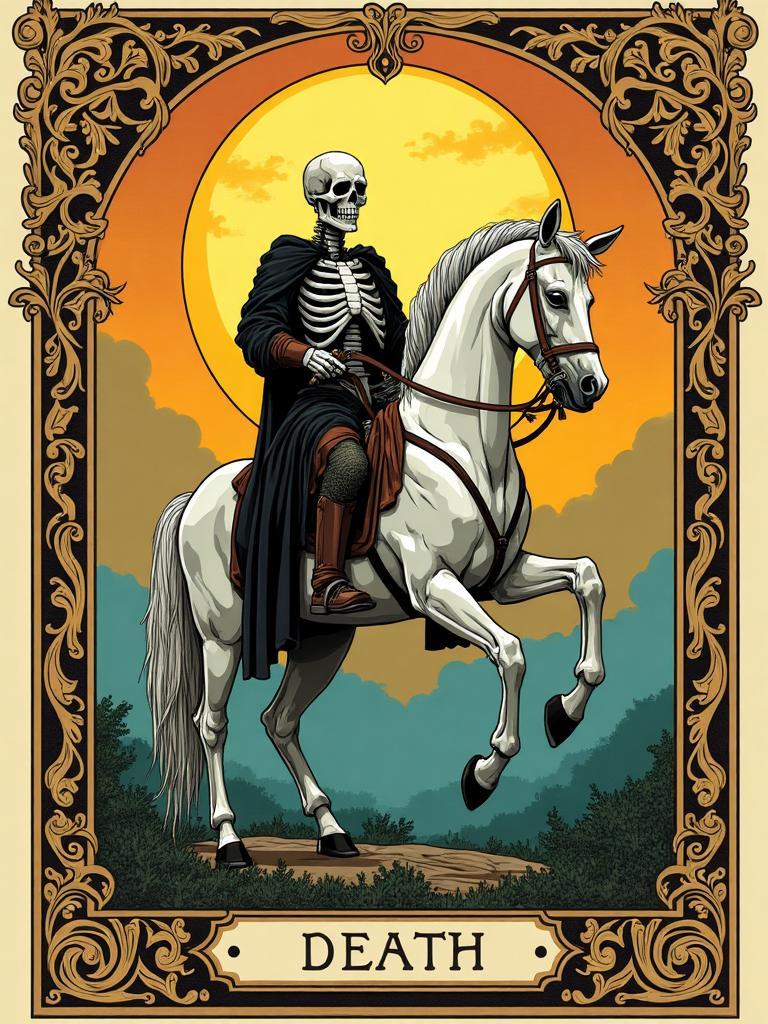
Death in a tarot decision reading is about one chapter closing so another can begin. If you are looking up the Death tarot decision meaning because the card landed on your question, take a breath: it almost never refers to physical death. In a decision spread, Death points to a necessary ending and asks whether you are ready to let go. Below you will find the yes or no answer, the card upright and reversed, and practical advice for the choice you face.
Death Yes or No: Yes to Change, No to Holding On
Death gives a two-sided answer. It is a yes to the option that involves change, release or a clean break. It is a no to keeping things as they are. If your question is "Should I end this?", the card leans toward yes. If it is "Can I save this as it was?", the card leans toward no.
The reasoning lies in the number. Death is card XIII of the Major Arcana, and thirteen sits after twelve, the number of a complete cycle, like twelve months or twelve hours. Thirteen is the step past completion. The card is saying that what you are deciding about has already completed its cycle, and the real question is how you will move on.
Reading the Image: Skeleton, Horse and Rising Sun
In the Rider-Waite card, a skeleton in black armour rides a white horse. He carries a black flag bearing a white rose with five petals, a symbol of renewal and of life that continues beyond change. The white horse suggests purity of purpose: this ending is not cruel, it is simply clear.
In front of the horse, figures react differently. A king lies fallen, his crown on the ground, showing that status and control cannot stop change. A bishop stands with his hands joined, meeting the moment with acceptance. A young woman turns her face away, and a child looks up openly. These are the ways people respond to a hard decision: resisting, accepting, avoiding or simply facing it.
In the background a river flows, a small boat drifts on it, and the sun rises between two towers. That rising sun is the key to the card in a decision. The ending in the foreground opens onto a new day in the distance.
Death Upright in a Decision
Upright, Death says something has run its course. A job, a relationship, a plan or a role you have played may have served its purpose. The decision is not really whether it ends, but whether you consciously choose that ending or let it drag on.
The card favours a clean cut over patchwork repairs. If you have been trying to fix the same structure over and over, Death suggests the structure itself is finished. Choosing the option that creates real space, even if it hurts, is often the healthier path.
Upright Death also asks for courage with the empty space that follows. You may not yet know what comes next. The card suggests that this gap is part of the process, not a sign that you chose wrong. Honour what was, carry its lessons forward and trust that new ground can only be planted once the old has been cleared.
Typical Decision Situations for Death
Death tends to show up when a choice involves leaving something behind. Common examples:
- Resigning from a role you have outgrown, even though it feels familiar and safe.
- Ending a relationship or friendship that no longer supports either person.
- Moving away from a place, a community or a lifestyle you have identified with for years.
- Closing a business, project or chapter of study that has stopped growing.
- Letting go of a belief or self-image, such as "I am someone who never gives up", that keeps you stuck.
In each of these, Death highlights that the difficult part is often emotional rather than practical.
Death Reversed in a Decision
Death reversed points to resistance. You may already know the answer but keep postponing the decision because the ending feels too painful. The reversed card warns that holding on to what has already gone tends to prolong discomfort rather than prevent loss.
Reversed Death can also show stagnation. When a needed change is delayed, life can feel flat and repetitive, as if you are waiting in a room you have already left. The card reminds you that transformation delayed is not transformation avoided. If you do not choose the ending, circumstances may eventually choose it for you, usually with less grace.
Be gentle with yourself here. Endings are genuinely hard, and the reversed card is not a judgement. It is an invitation to loosen your grip a little, to admit what has changed and to allow yourself to move forward at a pace you can manage.
Advice: How to Decide With Death
Start by naming what is already over. Write a short list of the things in this situation that no longer feel alive: conversations, routines, hopes. Seeing them on paper makes the decision less abstract.
Allow yourself to grieve. Choosing an ending does not mean you feel no sadness. Make room for that feeling instead of using it as proof that you are making a mistake.
Plan a respectful ending. Death is thorough, but it is not careless. Think about how to close this chapter with fairness to others: honest conversations, proper notice, tying up loose ends.
Try a simple ritual. Write down what you are releasing and what you hope to welcome, then fold away or dispose of the first page and keep the second where you can see it. Small symbolic acts help your mind accept that the decision is real.
What Death Asks of You Now
Death in a decision reading is not a threat; it is a reflection of a transition that is already underway. Use the card as a prompt for honest self-reflection rather than a prediction. Choose the ending that makes space, treat what you leave behind with respect and keep your eyes on the sun rising between the towers.
Questions for Self-Reflection
- What part of this situation already feels finished, even if I have not admitted it yet?
- What am I afraid to lose if I close this chapter, and is that fear about the past or the future?
- Which version of myself am I protecting by not deciding?
- What would I want to take with me from this chapter into the next one?
What This Card Does NOT Mean
- It does not mean physical death or that something terrible will happen to you.
- It does not mean every part of your life is about to fall apart at once.
- It does not mean you should end things abruptly without care for the people involved.
Typical Life Situations
- You are deciding whether to leave a job you have outgrown but still feel attached to.
- A relationship has run its course and you are weighing whether to end it.
- You are considering moving away from a city that no longer feels like home.
- You keep reviving an old project or habit that no longer brings you anything.
Important Card Combinations
- The Fool: A powerful 'reset' button; the old life ends completely, and you immediately step into a brand-new, unknown adventure with a clean slate.
- Judgement: A definitive crossroads where you are called to leave the past behind once and for all after a moment of profound realization or awakening.
- The Tower: A more jarring transition where the 'death' of a situation is forced by external circumstances, demanding immediate and total transformation.
- Temperance: A graceful transition period; as one door closes, you are encouraged to find balance and integrate the lessons of the past into your new reality.