Six of Swords – Tarot Card Meaning
Psychological analysis of the Six of Swords: Discover the meaning of mental transition, resilience, and the journey toward inner clarity and healing.
Core meaning
The Six of Swords represents a transition from a state of inner or outer turmoil toward calmer waters. It symbolizes the conscious decision to leave a difficult situation behind and move toward a more stable, objective mental state.
Six of Swords upright meaning
Moving toward calmer waters. The Six of Swords shows transition from troubled times to better shores.
Difficult passage leads to easier times. Trust the crossing.
Leave the storm behind. The journey to peace has begun.
Six of Swords reversed meaning
Stuck in troubled waters or resistance to moving on. Face the journey.
Healing journey is delayed. Something needs resolution first.
The transition stalls or returns. Examine what holds you back.
Six of Swords in love
Relationship transition or leaving difficult love behind.
Love requires leaving troubled patterns. Move forward.
Six of Swords in career and finances
Professional transition to better circumstances.
Career journey takes you from difficulty to improvement.
Six of Swords spiritual meaning
Spiritual journey from struggle to peace. Trust the passage.
Transition from spiritual difficulty to understanding. Keep going.
The card's advice
Trust the transition process. Better times are ahead.
Moving on is the path to peace. Don't look back.
Six of Swords: yes or no?
Maybe. In a yes/no question, Six of Swords gives no clear signal: the answer depends on your next step.
Reflection
Psychologically, this card reflects the process of cognitive restructuring and the mourning that accompanies change. It embodies the archetype of the 'Rite of Passage,' where one must carry the weight of past experiences (the swords in the boat) while navigating toward a new identity. This transition often feels somber or weary because it requires letting go of familiar, albeit painful, patterns. It highlights the human capacity for resilience and the intellectual clarity needed to distance oneself from emotional chaos in order to heal.
Typical questions
- What mental or emotional baggage am I taking with me into this new chapter?
- Am I moving toward a solution, or am I merely trying to escape a necessary confrontation?
- What internal clarity is required for me to find peace in this transition?
- How can I support myself during this 'in-between' phase where the old is gone but the new is not yet reached?
- What beliefs am I finally ready to leave behind to ensure my mental well-being?
What it does not mean
This card does not signify a 'magical' disappearance of problems or a joyful victory; rather, it is a sober, necessary movement. It is not a prediction of a physical journey or travel, but a metaphor for a shift in consciousness. Furthermore, it should not be misinterpreted as a sign of weakness or 'giving up,' but as a strategic and healthy withdrawal from a toxic or stagnant environment.
Six of Swords symbolism: what the card shows
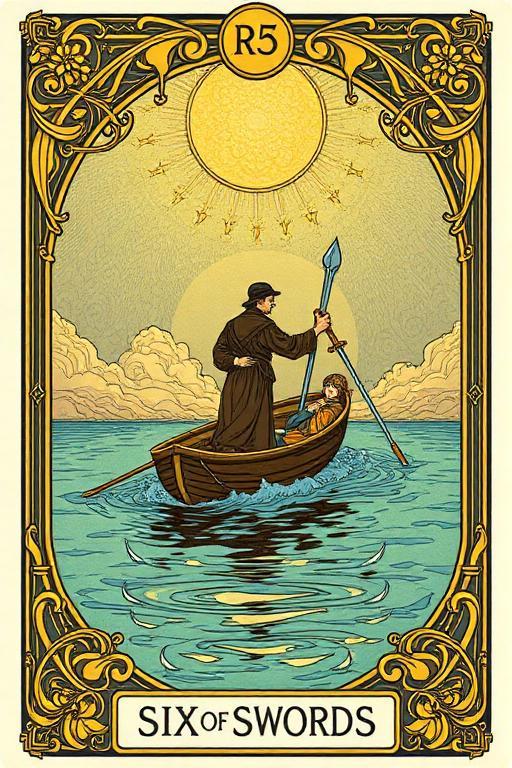
In the classic Rider-Waite-Smith deck, drawn by Pamela Colman Smith in 1909, the Six of Swords shows a quiet crossing. A ferryman stands at the back of a small boat and pushes it forward with a long pole. In front of him sit a cloaked, hunched figure and a child, both turned away from us, facing the far shore. Six swords stand upright in the boat, their points sunk into the wood. The water beside the boat looks ruffled, while the water further ahead lies smooth.
The details carry the meaning. Swords are the suit of air: thoughts, words and the conflicts they create. Here the swords are not fought with; they are carried along, like memories you cannot simply throw overboard. Six is a number of balance after the struggle of the Five, so the card describes recovery rather than triumph. The ferryman matters too: this crossing is not made by willpower alone. Sometimes moving on means letting someone or something steady the boat for you, and being content to arrive slowly.
Six of Swords reversed in love
Reversed, the Six of Swords in love often describes a crossing that keeps getting postponed. In a couple, it can show the conversation you both know you need, about moving cities, about money, about an old hurt, being pushed back week after week because the current situation, though tiring, at least feels familiar. It can also show a relationship that left the rough water once and then drifted back into the same argument, as if no one had picked up the pole again.
For singles, the reversed card often points to an ex who still travels with you: you compare every new date with them, or you keep their messages "just in case". It does not mean you are stuck for good. It asks what you would have to put down to make room. Writing down which habits from the old relationship you want to leave on the shore can be a surprisingly practical start. For the upright card and calmer waters in relationships, read the Six of Swords love meaning.
Six of Swords as feelings
Asked "what do they feel for me?", the Six of Swords tends to describe a calm, slightly tired kind of affection. The person may feel relief around you, as if being with you is the quieter water after a stormy stretch in their life. That can be a sincere feeling, but it is often more about safety than about fireworks, and they may still be carrying something unfinished from before. Patience usually fits this card better than pressure.
Reversed, the feelings can look like hesitation: they want to come closer but keep looking back at an old situation, or they are not yet ready to let go of the shore they know. The card can sketch a mood, but only they can tell you what they actually feel.
Six of Swords: yes or no?
Maybe – the Six of Swords does not say yes or no on its own; it asks whether you are willing to make the crossing. The answer moves towards yes when your question is about leaving something difficult behind: "Should I take the new job in another city?" or "Is it time to end this lease?" It moves towards no when you hope the problem will disappear without any change on your part. Reversed, the maybe becomes "not yet": something still needs to be settled before you leave. You can test your own question with the one-card yes or no tarot.
Six of Swords as your card of the day
As your card of the day, the Six of Swords favours steady progress over big gestures. Watch for moments when you could quietly step away from a tense situation instead of arguing it out once more: a group chat that keeps flaring up, a task you have redone three times. Today is good for transitions, even small ones, such as finishing one thing properly before starting the next. One practical action: pick a single item you have been carrying for too long, an unanswered email or a box of things from a past chapter, and deal with it before evening. Tomorrow you can draw a fresh free daily card.
Six of Swords as a person
As a person, the Six of Swords describes someone who knows how to get through hard times without making a scene. They are calm in a crisis, practical and quietly protective, often the one who drives a friend home after bad news or helps someone pack up and start over. Their strength is endurance: they keep moving even when they feel low. The shadow side is that they may leave rather than talk. Changing jobs, homes or circles can become a way of avoiding feelings that would be better spoken aloud. If this card describes you, it asks whether you are travelling towards something or only away from it, and whether you let others take the pole sometimes.
Six of Swords for health and wellbeing
For wellbeing, the Six of Swords often appears in a recovery phase: the worst stress may be behind you, but your energy has not fully come back. The card suggests treating this as a passage rather than a race. Gentle routines help, such as regular sleep, walks near water if you can, and fewer evenings spent replaying what went wrong. It also asks you to notice which worries you are still carrying out of habit. This is an invitation to reflect, not medical advice, and anything that concerns your health is best discussed with a doctor.
Six of Swords affirmation
"I can leave the rough water behind without having to forget it."
"I move towards calmer days at my own pace, and I accept help along the way."
Six of Swords: frequently asked questions
Does the Six of Swords mean travel or moving house?
Many people read it that way because of the boat, and it often shows up when a move or a trip is being discussed. On this site, though, the card is read as an inner transition rather than a forecast of travel. If you are planning a move, the Six of Swords asks what you hope to leave behind and whether that will really stay on the old shore. The question of where you go comes second.
What does the Six of Swords mean with the Three of Swords?
Together, the two cards tell a story of hurt and recovery. The Three of Swords names the pain, a disappointment or a hard truth, while the Six shows the slow journey away from it. In a reading, the pair often suggests that healing has already begun, even if it does not feel that way yet. It invites you to stop reopening the wound in conversation and let the distance do some of the work.
Is the Six of Swords a good card when deciding?
It is a helpful card rather than a lucky one. When a choice feels heavy, the Six of Swords points to the option that brings more peace, even if it is less exciting or means admitting that something has run its course. It rarely favours staying in a conflict out of pride. For a closer look at weighing options with this card, see the Six of Swords in decisions.