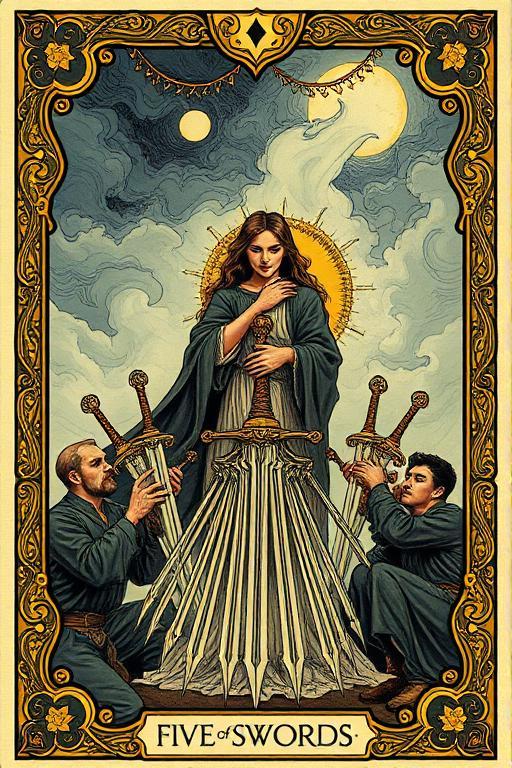
Five of Swords – Tarot Card Meaning
Explore the psychological depth of the Five of Swords: a card of hollow victories, ego-driven conflict, and the importance of choosing your battles wisely.
Core meaning
The Five of Swords signifies a hollow victory where the cost of 'winning' far outweighs the actual gain. It represents a conflict driven by the ego, resulting in social fragmentation and the bittersweet realization that dominance often leads to isolation.
Five of Swords upright meaning
Victory may come at too high a cost. The Five of Swords shows conflict where no one truly wins.
Conflict creates casualties on all sides. Choose your battles wisely.
The battle is won but at what price? Consider whether this fight is worth winning.
Five of Swords reversed meaning
Moving past conflict or accepting defeat. Peace is possible.
Learning from defeat or releasing need to win. Growth from conflict.
The fight ends, one way or another. Time for reconciliation.
Five of Swords in love
Relationship conflict with no winners. Seek resolution.
Romance needs conflict resolution. Pride costs too much.
Five of Swords in career and finances
Professional conflict or unethical advantage. Consider the cost.
Career advancement at others' expense backfires. Stay ethical.
Five of Swords spiritual meaning
Ego battles obstruct spiritual growth. Surrender the fight.
The need to win blocks higher wisdom. Let go.
The card's advice
Consider whether winning is worth the cost. Not all battles should be fought.
Examine your role in conflict. Is ego driving the fight?
Five of Swords: yes or no?
No. In a yes/no question, Five of Swords leans towards no: look at what is holding you back or warning you.
Reflection
Psychologically, this card reflects the 'Pyrrhic victory' archetype, where the need to be right overrides the value of human connection. It mirrors inner processes of resentment and the shadow side of competition, highlighting how aggressive self-assertion can mask deep-seated insecurities. This card invites us to examine our defensive mechanisms and the destructive power of a pride that refuses to seek common ground. Growth in this stage comes from recognizing when a battle is no longer worth the emotional or relational toll it exacts.
Typical questions
- What is the true price I am paying for 'winning' this specific argument or conflict?
- Am I defending a core value, or am I merely protecting an inflated sense of ego?
- How does my current need for dominance affect my sense of belonging and long-term peace?
- What part of me feels so threatened that it believes it must defeat others to feel safe?
- What would change if I prioritized reconciliation and integrity over being right?
What it does not mean
This card is not a prophecy of inevitable defeat or a warning of 'evil' external enemies. It should not be misinterpreted as a sign that one is a helpless victim of fate; rather, it analyzes the dynamics of a specific interaction. It does not advocate for passivity, but warns against the psychological exhaustion caused by toxic or unnecessary confrontation.
Five of Swords symbolism: what the card shows
The scene in the classic Rider-Waite-Smith deck, painted by Pamela Colman Smith in 1909, looks like the end of a skirmish. In the foreground a young man holds three swords and looks back over his shoulder with a faint, satisfied expression. Two more swords lie on the ground at his feet. Further away, two figures walk off towards the water with their backs to him; one seems to hold a hand to his face, as if in shame or grief. Above them, the sky is torn by jagged, windblown clouds.
Read together, the details describe a win that leaves the winner alone. He has collected the weapons, so on paper the contest is his, yet nobody stayed to share the moment. Swords are the suit of air and the mind, which points to battles fought with words, arguments and strategy rather than fists. After the rest of the Four of Swords, the Five brings the mind back into contest, this time with a clear loser. The restless sky shows that the atmosphere has not cleared, even though the fight is over.
Five of Swords reversed in love
Reversed, the Five of Swords in love often describes the moment after a fight when pride decides what happens next. For couples, it can show a long-running argument finally losing steam: you are both tired of scoring points about whose family gets Christmas or who forgot what. That opens a door to apologise and repair, if one of you is willing to stop needing to win. The reversed card can also point to resentment that lingers after a "resolved" conflict, where one partner gave in to keep the peace and quietly keeps the score.
For singles, the card may relate to leaving a relationship where you always lost the argument, and learning to trust your own perspective again. It can also ask whether you bring a defensive stance into new dating, ready for a battle before anyone has attacked. Choosing curiosity over defence is often the first step. For the upright side, see the Five of Swords love meaning.
Five of Swords as feelings
When you ask "what do they feel for me?" and draw the Five of Swords, the card tends to point to feelings coloured by tension. The person may feel hurt, defensive or resentful after a conflict between you, or they may still be caught up in proving a point. Some of that can be pride rather than a lack of care: they might miss you and still refuse to make the first move. In other cases, the card reflects a dynamic of competition, where attraction and rivalry are hard to tell apart.
Reversed, it can suggest that they are tired of the struggle and more open to making peace, or that they regret how something was handled. Read this as a reflection to weigh against what you know, because no card can confirm what is going on inside another person; only they can.
Five of Swords: yes or no?
No – the Five of Swords leans towards no, because even a "yes" here would likely come at a cost that outweighs the gain. The card fits questions such as "Should I push to win this argument?", "Should I take the promotion if it means stepping on a colleague?" or "Should I send that angry message?" Its answer is to look again at what you would really be winning. Reversed, the answer is still no for the plan as it stands, while the door to a different, fairer approach opens. You can ask about your own situation through the one-card yes or no tarot.
Five of Swords as your card of the day
As your card of the day, the Five of Swords suggests that a small conflict may tempt you today. It could be a comment in a meeting, a disagreement in a group chat or a sibling picking at an old sore spot. Notice the urge to have the last word, and ask whether the point is worth what it could cost the relationship. Sometimes stepping back is the stronger move. One practical step: if a disagreement starts, try saying "Let me think about that" instead of firing back, and come back to it once you are calmer. A fresh card is available every day at the free daily card.
Five of Swords as a person
As a person, the Five of Swords describes someone who is quick, competitive and very hard to beat in an argument. They are often sharp strategists, good negotiators and fearless about conflict that others avoid. In the right setting, such as a debate, a tough negotiation or a situation where someone needs defending, these qualities are an asset. The shadow side shows when winning becomes the goal in itself: they may twist words, keep score, refuse to admit mistakes or leave a trail of quietly alienated friends and colleagues. If this card describes you, it asks whether your victories are bringing you closer to the people who matter, or leaving you holding the swords on your own.
Five of Swords for health and wellbeing
For wellbeing, the Five of Swords points to the stress of ongoing conflict. Constant arguments, at home or at work, can leave you on edge, sleeping badly and replaying conversations long after they ended. The card encourages you to notice which battles drain you most and whether some can be dropped or postponed. Physical outlets such as a run, a long walk or a workout can help discharge tension, and so can talking a situation through with someone outside it. This card supports reflection and is not medical advice; for health worries, the right place to go is a doctor.
Five of Swords affirmation
"I do not need to win every argument to know my own worth."
"I choose peace where pride would only leave me alone."
Five of Swords: frequently asked questions
Does the Five of Swords point to a narcissist or a bully?
People ask this because the card shows someone gloating over a victory. It does not diagnose anyone. It describes a dynamic in which winning matters more than fairness, and that dynamic can involve you, the other person or both. If you feel someone regularly belittles or outmanoeuvres you, the card encourages you to take that seriously and set boundaries. It can also ask, gently, whether you play that role yourself at times.
What does the Five of Swords mean with the Seven of Swords?
Together, these two cards strongly highlight strategy, secrecy and gaining an advantage in ways that may not be entirely fair. The Seven of Swords adds cunning and getting away with something; the Five adds the cost of doing so. The pair can point to office politics, a hidden agenda or a situation where honesty has been bent. It invites you to act with integrity, even when someone else is not.
What does the Five of Swords mean for getting back together?
If you are asking about reconciliation after a breakup, the card suggests that the old pattern of conflict needs attention first. Returning to the same arguments with the same aim of proving who was right is likely to repeat the hurt. Reversed, it can point to a more honest conversation becoming possible. To think the choice through step by step, read the Five of Swords in decisions.