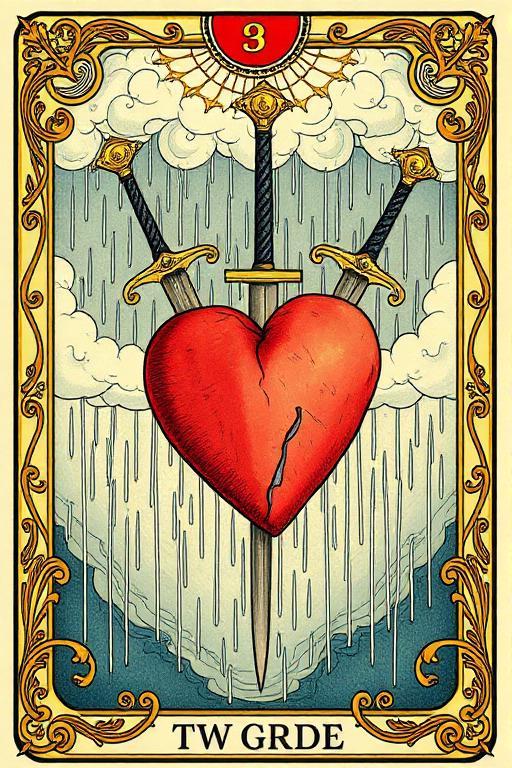
Three of Swords – Tarot Card Meaning
Explore the psychological meaning of the Three of Swords. Learn about grief processing, cognitive dissonance, and finding clarity through emotional pain.
Core meaning
The Three of Swords represents the experience of acute emotional pain, grief, or the sobering realization of a difficult truth. it symbolizes the moment when the intellect pierces through emotional illusions, leading to a necessary but painful clarity.
Three of Swords upright meaning
Heartbreak and sorrow pierce deeply. The Three of Swords acknowledges emotional pain that must be felt to heal.
Pain is real but not permanent. Feel fully to heal fully.
The heart learns through suffering. Allow the grief to flow.
Three of Swords reversed meaning
Beginning to heal from heartbreak. Pain releases.
The worst is over. Healing replaces acute pain.
Grief processed and releasing. Recovery is underway.
Three of Swords in love
Heartbreak in love. Allow grief to move through.
Love's wound requires tender attention. Grieve honestly.
Three of Swords in career and finances
Professional disappointment or loss. Acknowledge the pain.
Career blow needs emotional processing. Don't suppress.
Three of Swords spiritual meaning
Spiritual heartbreak or dark night. Pain opens depth.
Spiritual pain carves deeper capacity for love. Trust the process.
The card's advice
Allow yourself to grieve. Suppressed pain only wounds longer.
This too shall pass. Honor your pain as part of healing.
Three of Swords: yes or no?
No. In a yes/no question, Three of Swords leans towards no: look at what is holding you back or warning you.
Reflection
Psychologically, this card mirrors the process of cognitive dissonance and the subsequent 'heartbreak' that occurs when reality clashes with our desires. It reflects the archetype of the Wounded Healer, suggesting that acknowledging one's vulnerability is a prerequisite for genuine psychological integration. The swords represent the power of the mind to cut through denial, which, while painful, prevents the stagnation of the self in a false narrative. This stage is often a catalyst for growth, forcing the individual to process repressed emotions and develop resilience through the honest navigation of sorrow. It highlights the necessity of grieving as a functional response to loss or disillusionment.
Typical questions
- What painful truth am I currently trying to avoid or intellectualize?
- How can I allow myself to fully experience my grief without becoming lost in it?
- In what ways is my current emotional pain a signal that an old illusion is finally breaking?
- Where is my logical understanding of a situation causing a conflict with my emotional needs?
- What part of my past identity am I mourning, and what space does this loss create for my future self?
What it does not mean
This card is not a 'bad omen' or a prediction of inevitable external tragedy, such as a literal breakup or physical accident. It should not be interpreted as a sign of permanent suffering or victimhood, but rather as a transitory state of emotional processing. It does not suggest that pain is being inflicted by others, but focuses on the internal realization and the necessary release of attachments that no longer serve personal growth.
Three of Swords symbolism: what the card shows
Few tarot images are recognised as quickly as this one. In the classic Rider-Waite-Smith deck, created by Pamela Colman Smith in 1909, the Three of Swords has no people at all: a large red heart floats in the air, pierced by three swords that meet at its centre. Behind it, heavy grey clouds fill the sky and rain falls in slanting lines.
The absence of figures matters. The card is not about who did what; it is about the experience of hurt itself. The heart stands for love and attachment, and the swords, as the suit of air, stand for thoughts, words and realisations. So the pain here often comes through the mind: something said, something understood, a fact that cannot be unlearned. Three is the number of the first result in each suit, the moment a situation takes a definite shape. The storm and rain add the last layer. Grief is weather; it is intense while it lasts, and rain is also how a sky clears.
Three of Swords reversed in love
Reversed, the Three of Swords in love often shows the slow turn after a hurt. For couples, that might mean you are beginning to talk again after a betrayal, a lie or a painful argument, and the conversations are shorter and less raw than they were. It can also describe a wound you both stepped around: an old affair, a lost pregnancy, a family member who was never accepted. The reversed card asks whether it is being healed or just packed away, because a hurt pushed aside tends to resurface in small arguments.
For singles, the reversed card frequently marks the period when an ex stops being your first thought in the morning. You may notice that a song or a street no longer stings in the same way. That does not mean you need to rush back into dating; it means some energy is returning. Let it come back at its own pace. The upright meaning of this card in relationships is covered in the Three of Swords love meaning.
Three of Swords as feelings
If you ask "what do they feel for me?" and the Three of Swords appears, it usually points to feelings marked by hurt. The person may be disappointed in you, or in the situation between you; they may feel let down by something that was said or done. Equally, the hurt may not be about you at all. They may still be grieving a past relationship and feel unable to open up. The card speaks of sadness more than anger, and of feelings that are honest but heavy.
Reversed, it can suggest that the pain is beginning to soften and that they are working through it, even if they are not ready to show much yet. Keep in mind that the card mirrors patterns and possibilities. It cannot tell you with certainty what is in someone else's heart, so let their own words count for more than the card.
Three of Swords: yes or no?
No – the Three of Swords leans towards no, because the situation behind your question carries a wound that has not been dealt with. Pushing ahead now could repeat the hurt rather than resolve it. The card answers questions like "Should I get back together with my ex?" or "Should I forgive and move on right away?" by asking you to slow down and feel what happened first. Reversed, the answer is still no for the moment, yet it is gentler: healing is underway, and a later question may land differently. You can ask about your situation with the one-card yes or no tarot.
Three of Swords as your card of the day
As your card of the day, the Three of Swords does not predict a sad day. It asks you to be kind to whatever is sore right now. You might hear a comment that stings, remember an old loss, or notice disappointment you have been brushing off. Watch for the reflex to say "it's fine" when it is not. One small action: give a feeling ten honest minutes today, perhaps by writing an unsent letter, crying if you need to, or telling one trusted person what is really going on. Then do something soothing and ordinary. You can draw a new card tomorrow at the free daily card.
Three of Swords as a person
As a person, the Three of Swords describes someone who has known real hurt and been shaped by it. They are often deeply empathetic, quick to understand when others are struggling and unwilling to offer empty comfort. Their honesty about pain can make them trusted friends in hard times. The shadow side is that the wound can become an identity: they may expect disappointment, keep people at a distance to avoid being hurt again, or replay old injuries long after they have passed. If this card describes you, it does not ask you to be over it. It asks whether your sorrow is still moving, or whether it has started to settle into the way you see everything.
Three of Swords for health and wellbeing
For wellbeing, the Three of Swords highlights how heavily grief and heartbreak can weigh on your energy. Sadness can disturb sleep, appetite and concentration, and it often makes ordinary tasks feel slower. The card encourages gentle structure: regular meals, fresh air, some movement, and people you can be honest with. It also reminds you that suppressed sorrow tends to find other ways out, so allowing yourself to feel is part of looking after yourself. This card is a prompt to reflect and does not replace medical advice; if low mood or physical symptoms persist, please speak to a doctor.
Three of Swords affirmation
"My heart can hurt and still heal."
"I let myself feel this fully, and I trust that the rain will pass."
Three of Swords: frequently asked questions
Does the Three of Swords mean cheating?
This is one of the most common questions about the card, because the three swords are sometimes read as a love triangle. The card does not prove infidelity. It describes heartbreak and a painful truth, which can include betrayal but just as often means a misunderstanding, a loss or a disappointment. If you suspect cheating, the card invites you to look at what you have actually noticed and to find a way to talk about it openly.
What does the Three of Swords mean with the Six of Swords?
The Six of Swords shows a crossing to calmer waters. Next to the Three, it often describes moving on from a heartbreak: the hurt has happened, and now a transition begins, perhaps a move, a new routine or a clear decision to leave something behind. The pair suggests that sadness can travel with you without steering the boat, and that distance, in time or place, may help the healing.
Can the Three of Swords ever be a positive card?
It is never a light card, but it can be a useful one. It names pain clearly, and naming is often the first step towards releasing it. In a reading, the card can confirm that what you are feeling is valid, that a truth has been seen, and that grief is part of a process rather than a dead end. Its gift is honesty, even though that honesty hurts.