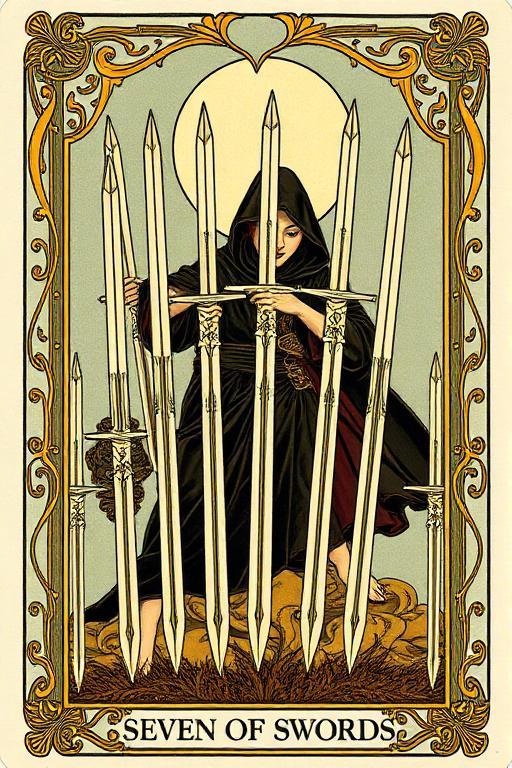
Seven of Swords – Tarot Card Meaning
Deep dive into the Seven of Swords: Psychological insights on strategy, evasion, and the Trickster archetype for self-reflection and personal growth.
Core meaning
The Seven of Swords represents strategic thinking, non-conformity, and the attempt to achieve an objective through cleverness or evasion rather than direct confrontation. It symbolizes the tension between individual ingenuity and the established norms or collective expectations.
Seven of Swords upright meaning
Strategic thinking or deception at play. The Seven of Swords shows cunning—but whose, and to what end?
Cleverness serves or deceives. Examine motivations carefully.
Not everything is as it appears. Someone may be working behind the scenes.
Seven of Swords reversed meaning
Deception revealed or returned. Truth comes to light.
The sneaky approach fails. Try honesty instead.
Strategy backfires or conscience returns. Face what's been hidden.
Seven of Swords in love
Secrets or dishonesty in love. Seek truth.
Relationship needs honesty. Hidden agendas damage trust.
Seven of Swords in career and finances
Strategic moves or workplace politics. Navigate carefully.
Career strategy requires ethical boundaries. Don't cross lines.
Seven of Swords spiritual meaning
Self-deception or avoiding spiritual truth. Be honest.
Spiritual growth requires absolute honesty. No shortcuts.
The card's advice
Be strategic but ethical. Cleverness without integrity backfires.
If deception is around you, proceed carefully. If it's from you, reconsider.
Seven of Swords: yes or no?
No. In a yes/no question, Seven of Swords leans towards no: look at what is holding you back or warning you.
Reflection
Psychologically, this card explores the archetype of the 'Trickster' and the human tendency to use mental shortcuts or avoid conflict. It reflects a state where one might feel the need to act in isolation, perhaps due to a lack of trust in their environment or a fear of vulnerability. This card invites an honest look at self-deception, the 'imposter syndrome,' or the shadow side of pragmatism where the end is used to justify the means. It challenges the individual to examine whether their current strategy is a legitimate protective measure or a subconscious flight from responsibility and authentic connection.
Typical questions
- In what area of my life am I currently choosing a 'back door' instead of direct communication?
- What am I trying to protect by keeping my true intentions hidden from others?
- Am I being resourceful and clever, or am I merely avoiding a necessary confrontation with reality?
- Where might I be deceiving myself about the sustainability of my current strategy?
- How does my need for independence interfere with my integrity and social accountability?
What it does not mean
This card is not a prediction of being cheated on or a warning of an inevitable betrayal by others. It should not be misinterpreted as a moral condemnation or a sign of 'bad luck,' but rather as a prompt to evaluate one's own mental strategies. It is not an invitation to engage in unethical behavior, nor does it guarantee that a 'sneaky' approach will be successful in the long term.
Seven of Swords symbolism: what the card shows
The Rider-Waite-Smith version of the Seven of Swords, painted by Pamela Colman Smith in 1909, shows a man tiptoeing away from a camp of tents. He carries five swords bundled in his arms and glances back over his shoulder. Two more swords remain stuck in the ground behind him. In the distance, near the tents, a few small figures seem not to have noticed anything yet. The background is a bright yellow sky, which makes the scene look oddly open for something done in secret.
Every detail adds a question. The swords stand for thoughts and plans, and he has taken most of them but not all: a strategy that is clever yet incomplete. His backward look shows that he expects to be seen. Five swords make an awkward armful, a hint that the plan may weigh more than he thinks. Seven, in the suits, often marks a test of character. Here the test is whether getting what you want quietly is wise, or simply easier than asking for it.
Seven of Swords reversed in love
Reversed in love, the Seven of Swords often points to something that no longer stays hidden, and that is not only about the other person. For couples, it can be the moment one of you finally says what you have been editing out of conversations: that you spend more than you admit, that you still talk to an ex, that you agreed to a plan you never wanted. Coming clean can feel uncomfortable, but it usually gives the relationship firmer ground than the quiet version did.
For singles, the reversed card often shows up around games that have stopped working: keeping several people on hold, playing it cool when you are not, or presenting a profile that is more strategy than self. It invites you to try plain honesty and see who stays. If you suspect someone is not being straight with you, ask a calm, direct question instead of collecting clues. The upright meaning is covered in the Seven of Swords in love.
Seven of Swords as feelings
If you ask what someone feels for you and draw the Seven of Swords, the card tends to describe feelings that are real but guarded. The person may be interested and still keep part of their life or their intentions to themselves, perhaps because they fear being hurt, perhaps because they are weighing options. You might notice it as mixed signals: warm in private, vague in public. The card suggests watching what they do over time rather than decoding every message.
Reversed, it can describe someone who feels uneasy about having held something back and wants to set it right. None of this is proof of what goes on in someone else's heart; it is material for your own reflection.
Seven of Swords: yes or no?
No – the Seven of Swords answers with a no, because the situation behind your question probably has a missing piece. Something is not being said, either by someone else or by you, and a yes built on half the facts tends not to hold. The card answers questions about trust and strategy especially clearly: "Should I sign without reading the small print?" or "Can I get away with skipping this step?" Reversed, the no softens into "not like this": once the truth is on the table, ask again. Draw one card for a question of your own with the yes or no tarot.
Seven of Swords as your card of the day
As your card of the day, the Seven of Swords asks you to keep your eyes open and your own hands clean. Be alert to shortcuts, both those offered to you and those you are tempted to take: a report you could pass off as finished, a promise you could quietly let slide. It is also a good day to protect your ideas, for example by noting in writing who agreed to what in a meeting. One small action: before you send anything important today, read it once more and ask whether every part of it is true. Draw a new card of the day tomorrow to see what follows.
Seven of Swords as a person
As a person, the Seven of Swords describes a quick, independent mind. This is someone who finds the side door when the main entrance is blocked, spots loopholes in a contract and rarely says everything they are thinking. At their best they are resourceful problem-solvers who get results where others give up, and they can be good company: witty, observant, never boring. The shadow side is a habit of working alone and trusting no one, which can slide into half-truths, keeping score or taking credit that was shared. If this card describes you, it asks whether your cleverness still serves the people around you, or only protects you from them.
Seven of Swords for health and wellbeing
For wellbeing, the Seven of Swords often asks where you are telling yourself a convenient story. Maybe you say you sleep enough while scrolling past midnight, or you skip the rest days your plan includes and call it discipline. The card is not about blame; it simply invites an honest inventory of your habits. Keeping a short, truthful note for a week, of sleep, breaks and energy, can show more than good intentions do. Take the card as a mirror for reflection; if something about your body or mood worries you, a doctor is the right person to ask.
Seven of Swords affirmation
"I choose honesty, even when a clever shortcut would be easier."
"My ideas are worth protecting, and I can protect them in the open."
Seven of Swords: frequently asked questions
Does the Seven of Swords mean someone is cheating?
It is one of the most common worries attached to this card, and the image of someone sneaking away explains why. The card does not prove infidelity, and it should not be used as evidence against anyone. It points to a hidden element in the situation, which can just as well be an unspoken fear, a secret about money or your own doubts. If trust is shaky, the card's advice is a direct conversation, not detective work.
Can the Seven of Swords be a positive card?
Yes, in the right context. When you face a stronger opponent, a rigid system or a situation where direct confrontation would only cost you, the Seven of Swords can stand for smart tactics: choosing your battles, keeping your plans private until they are ready, or negotiating rather than fighting. The line it asks you to watch is the one between discretion and deceit. Clever is fine; dishonest tends to come back to you.
What does the Seven of Swords mean with The Moon?
Both cards deal with what cannot be seen clearly, so together they ask for extra caution. The Moon adds uncertainty, projection and fear, while the Seven of Swords adds secrecy or strategy. The pair often appears when rumours, assumptions and missing facts get mixed up. It invites you to separate what you know from what you imagine, and to wait for clearer information before acting on suspicion.