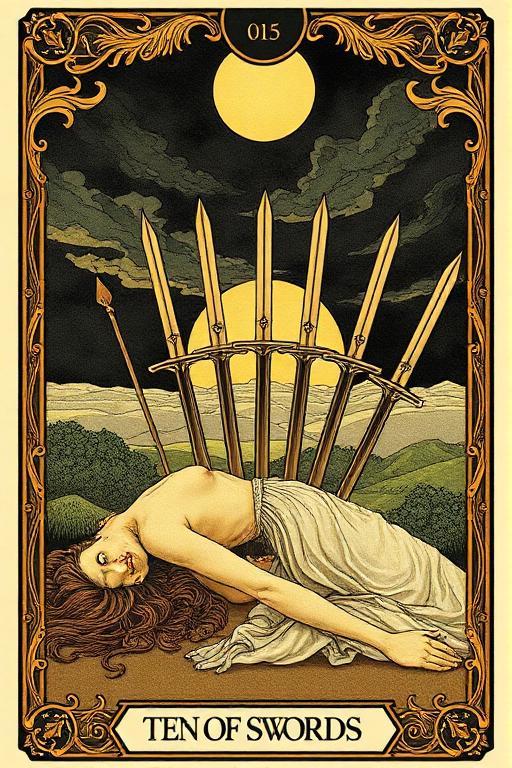
Ten of Swords – Tarot Card Meaning
Explore the psychological meaning of the Ten of Swords. Learn how this card represents endings, the release of victimhood, and the potential for renewal.
Core meaning
The Ten of Swords represents a definitive conclusion and the absolute end of a painful cycle or mental struggle. It marks the point where a situation has reached its limit, signifying that the worst is over and the only path forward is a new beginning.
Ten of Swords upright meaning
Rock bottom is reached. The Ten of Swords shows painful ending—but also that the worst is over.
Complete ending brings new beginning. The darkest moment precedes dawn.
When you can't go lower, the only way is up. Dawn breaks on the horizon.
Ten of Swords reversed meaning
Beginning to recover from crisis. The worst is definitely past.
The end wasn't as final as feared. Or you're resisting completion.
Rising from rock bottom. Recovery is underway.
Ten of Swords in love
Painful relationship ending. But space for new love opens.
Romantic rock bottom. The only way now is up.
Ten of Swords in career and finances
Professional crisis or complete ending. New beginnings await.
Work situation collapses. But fresh starts are possible.
Ten of Swords spiritual meaning
Spiritual crisis reaches its depths. Transformation follows.
Rock bottom of the soul. Dawn follows this darkest night.
The card's advice
Accept the ending completely. From this bottom, you can only rise.
Sometimes complete collapse precedes renewal. Trust the process.
Ten of Swords: yes or no?
No. In a yes/no question, Ten of Swords leans towards no: look at what is holding you back or warning you.
Reflection
From a psychological perspective, this card mirrors the experience of 'hitting rock bottom' or the collapse of an outdated ego-structure. It often highlights a tendency toward catastrophizing or maintaining an internal narrative of total defeat that, while painful, is necessary for ultimate transformation. By facing the finality of a situation, the individual is prompted to let go of victimhood and illusions, paving the way for profound psychological renewal. It serves as an archetype of the 'dark night of the soul,' where the death of the old self allows for the birth of a more resilient and authentic consciousness.
Typical questions
- In which area of my life am I refusing to accept that a cycle has come to its natural end?
- How is my internal narrative of being a victim preventing me from taking responsibility for my healing?
- What belief system or thought pattern has become so burdensome that it finally needs to be laid to rest?
- Now that I have reached the absolute limit of this situation, what is the very first step toward a new perspective?
- Where am I exaggerating my own suffering to avoid the uncertainty of starting over?
What it does not mean
This card is not a literal prediction of physical death, violence, or external disaster. It should not be viewed as a sign of permanent failure or a 'bad omen,' but rather as a psychological state of completion and the release of mental tension. It describes the subjective feeling of finality and the end of a thought process, not an inescapable fate dictated by external forces.
Ten of Swords symbolism: what the card shows
The Ten of Swords in the classic Rider-Waite-Smith deck, drawn by Pamela Colman Smith in 1909, is one of the most dramatic images of the Minor Arcana. A figure lies face down on the shore with ten swords standing in their back, a red cloth draped over part of the body. Above, the sky is black. Yet along the horizon a band of golden light is breaking, and beyond the figure lie still water and distant hills. One hand rests with its fingers in a gesture often compared to a sign of blessing.
The card is deliberately exaggerated. One sword would have been enough; ten say that this is complete, that there is nothing more to lose here. Ten is the final number of the suit, the point where the suit of air and thought has run its full course. That is why the light on the horizon matters as much as the swords: the night is ending, and the calm water suggests that the storm is over. The card shows the bottom of a cycle and, in the same picture, the first sign of the next day.
Ten of Swords reversed in love
Reversed in love, the Ten of Swords often describes the slow climb after a painful ending, or a refusal to let that ending be final. For someone recently separated, it can show the first mornings that feel almost normal: you sleep through the night, you cook for yourself again, you no longer check their profile every hour. It can also point to the opposite pattern, where you keep pulling the swords out one by one, rereading old messages and retelling the story of the breakup until it reopens.
For couples, the reversed card may appear after a serious crisis, such as a broken promise or a near split, when both of you are deciding whether to rebuild. It does not say whether you should; it asks whether you are building something new or only patching the old version. Rest, honest conversations and time are its usual advice. How the upright card reads in relationships is explored in the Ten of Swords in love.
Ten of Swords as feelings
If you ask what someone feels for you and draw the Ten of Swords, the card tends to describe exhaustion more than indifference. The person may feel that something between you has reached its end, or they may be so worn out by their own situation that there is little room left for new feelings. Sometimes it reflects hurt: they feel let down, and they are not ready to open up again. Pushing for an answer now rarely helps.
Reversed, it can suggest that they are slowly recovering and may look at the connection with fresh eyes once the pain has faded. How they really feel is theirs to say, in their own time.
Ten of Swords: yes or no?
No – the Ten of Swords answers no, and it is one of the clearest no's in the deck. It usually means that the thing you are asking about has already run its course, or that pushing further would only add another sword. It answers questions such as "Should I give it one more try?" or "Can I still save this project?" with a calm suggestion to accept the ending and save your strength for what comes next. Reversed, the no remains, but the focus shifts to recovery. A single card for your own question is waiting in the one-card yes or no tarot.
Ten of Swords as your card of the day
As your card of the day, the Ten of Swords is less ominous than it looks. It often points to something that has reached its limit: a long week, an argument you are tired of having, a plan that clearly will not work. Today asks you to stop pushing and call it what it is. One practical action: choose one thing you have been forcing and officially let it go, for example by cancelling an obligation or closing a draft you will never finish. Notice the relief that follows. For a new card tomorrow, use the free daily card.
Ten of Swords as a person
As a person, the Ten of Swords describes someone who has been through a great deal and is still here. They often have a dark, honest sense of humour, little patience for pretence and real compassion for others in crisis, because they know what rock bottom feels like. Their strength is resilience earned the hard way. The shadow side is a tendency to expect the worst or to tell their life as a series of betrayals, which can keep them in the role of the one who is always hurt. When this card describes you, it asks whether you are ready to look up and see the light on the horizon.
Ten of Swords for health and wellbeing
For wellbeing, the Ten of Swords often describes being completely drained, the feeling of having nothing left after a long stretch of stress. The card's message is simple: stop, lie down, let something end. Recovery may begin with very basic steps, such as sleeping more, eating regular meals and saying no to anything that is not essential for a while. It can also ask you to notice where you are still carrying a burden that has already ended. Use the card for reflection only, and talk to a doctor about anything that affects your health.
Ten of Swords affirmation
"This chapter is over, and I allow myself to rest before I begin again."
"Even here, I can see the first light on the horizon."
Ten of Swords: frequently asked questions
Does the Ten of Swords mean betrayal?
Betrayal is one of its traditional keywords, and the swords in the back make the image easy to read that way. The card does not accuse anyone, though. More often it describes the feeling of having been let down, by a person, a job or a hope, and the need to accept that this situation cannot be repaired as it was. It invites you to ask what you can still learn from it, rather than who to blame.
What does the Ten of Swords mean with Death?
Both cards speak of endings, so together they are a strong signal that something has truly finished. Death points to transformation and the natural close of a chapter; the Ten of Swords adds the pain and exhaustion of reaching that point. Neither card predicts a literal loss of life. The pair invites you to stop fighting what is already over and to make space for what can grow next.
What does the Ten of Swords mean in a decision?
In a decision reading, the Ten of Swords rarely recommends the option that requires holding on. It often favours ending a commitment that has already cost you too much, even if leaving feels like failure. The card also suggests not deciding while you are at your most exhausted; rest first, then choose. For more on using this card in choices, read the Ten of Swords in decisions.