The Hanged Man Tarot Spirituality: Surrender and Insight
The Hanged Man tarot in spirituality: surrender, ego death and a new perspective. Symbolism, a meditation practice, the reversed meaning and advice.
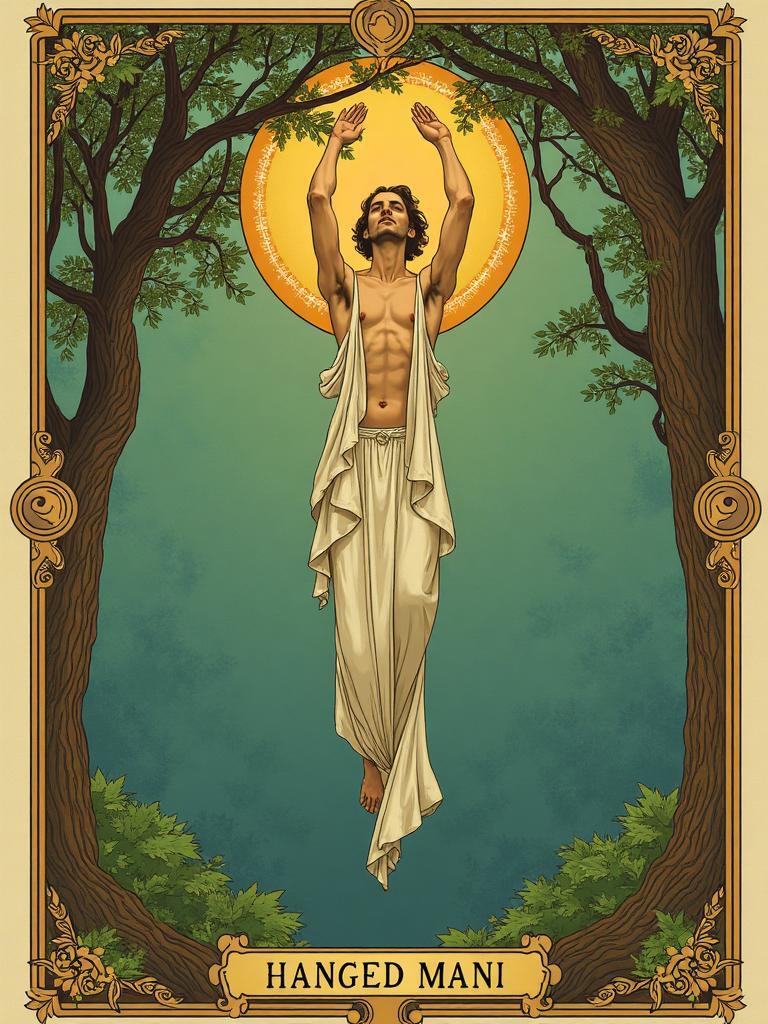
The Hanged Man in a tarot spirituality reading is the card of sacred surrender. As the twelfth card of the Major Arcana, it shows a figure suspended upside down, calm and luminous, and it tells you that your spiritual growth right now comes through letting go rather than striving. If you have drawn The Hanged Man on your spiritual path, you are in an in-between space where the old self loosens its grip and a new perspective slowly forms.
The Spiritual Lesson of The Hanged Man
The central lesson of The Hanged Man is that awakening cannot be forced. Most of us approach spiritual life with the same habits we use everywhere else: set a goal, work hard, measure progress. This card turns that approach on its head, literally.
Spiritual growth sometimes means letting your old self die. This is what many traditions call ego death: not a physical ending, but the gradual release of identities, roles and certainties that no longer fit. It is uncomfortable, often messy and entirely necessary. The Hanged Man asks you to surrender the person you were so that the person you are meant to be has room to emerge.
The deepest insights come through surrender, not effort. When you release your attachment to spiritual outcomes, such as a particular experience in meditation or a clear sign by a certain date, wisdom reveals itself in its own timing.
Symbolism of The Hanged Man
The Rider-Waite image is full of quiet detail, and each element speaks to the spiritual meaning of the card.
The living tree
The figure hangs by his right foot from a T-shaped cross made of living wood, with green leaves sprouting from it. This is not a gallows. The tau shape is an ancient symbol of life and the tree of the world, linking heaven and earth. The mystic hangs between worlds, held by something alive.
The halo and the calm face
A golden halo shines around his head, and his expression is serene. He is not suffering; he is seeing. The halo shows that illumination arrives precisely in this upside-down position, when ordinary ways of looking have been suspended.
Colours, posture and number
He wears a blue tunic, the colour of calm and inner knowledge, over red tights that represent passion and the physical body. His yellow shoes and hair echo the halo's light. His left leg is bent behind the right knee, forming a cross or the number four, while his hands are hidden behind his back, suggesting a triangle. Spirit sits above matter, even when the world appears inverted.
The number twelve reduces to three (1 + 2), the number of creation and growth, and reversed it becomes twenty-one, The World. Many readers see this as a hint that suspension is a step towards completion.
The Hanged Man Upright on the Spiritual Path
Upright, The Hanged Man describes a phase of incubation. Nothing seems to move on the surface, yet important shifts are forming underneath. You may notice that practices which once felt alive now feel flat, or that old answers no longer satisfy you. This is not failure. It is the stillness in which divine wisdom descends.
If you are in a spiritual limbo, treat it as sacred space. The in-between is exactly where transformation happens. Typical signs that you are in a Hanged Man phase include:
- A strong urge to pause, withdraw or simplify your practice
- Old beliefs feeling suddenly unconvincing or too small
- Synchronicities and dreams that invite you to see things differently
- An inner sense that you are waiting for something you cannot yet name
Be patient with your awakening. The clarity that emerges from this pause is usually worth far more than anything you could have forced.
A Hanged Man Practice: The Inverted View
This practice combines a short meditation with a journaling prompt. Set aside twenty minutes in a quiet place.
Step one: settle. Sit or lie comfortably and breathe slowly for a few minutes. Let your exhale be slightly longer than your inhale, signalling to your body that it is safe to stop doing.
Step two: visualise the card. Picture yourself as the figure on the living tree. Feel the support of the branch, the calm in your face and the warmth of a soft light around your head. Notice what changes when you stop trying to get anywhere.
Step three: invert one belief. Bring to mind a spiritual question that has been troubling you. Then ask: "What if the opposite were true?" Stay with that thought without judging it.
Step four: write. Open your journal and complete this prompt: "If I stopped striving for an answer, I would notice that…" Write for ten minutes without stopping.
Repeat the practice for a week and read your entries together. Patterns often appear that were invisible from your usual angle.
The Hanged Man Reversed on the Spiritual Path
The Hanged Man reversed shows resistance to a surrender that is already due. You may be clinging to a practice, teacher, belief or self-image that has served its purpose. That resistance prolongs the discomfort, because the lesson of patience has not yet been integrated.
The reversal can also point in the opposite direction: you have been dangling in limbo for too long. You have done the reflection, and now the time has come to either accept what you have seen or act on it. Spiritual waiting can turn into avoidance when it becomes a place to hide from change.
In both cases, the message is similar. Sometimes we hold on longer than necessary because change is frightening. The discomfort of holding on has now become greater than the discomfort of letting go. Ask yourself what you must release, and be honest about whether your pause is still sacred or simply stuck.
Advice from The Hanged Man for Your Spiritual Growth
The Hanged Man's advice is to trust the process and loosen your grip on how your path should look. Practically, this can mean reducing your practice to its simplest form, taking a break from seeking new techniques, or spending more time in silence and nature.
Let go of timelines. Awakening rarely follows a schedule, and comparing your progress with others only adds tension. Instead, notice what is shifting quietly inside you.
Finally, remember that surrender is an active choice, not resignation. The figure on the card has chosen his position, and his face shows peace rather than defeat. When you choose to pause consciously, you allow transformation to work through you, and you will recognise the moment when it is time to step down from the tree and walk on with new eyes.
Questions for Self-Reflection
- Where in my spiritual life am I trying to force a result that needs time?
- Which old version of myself am I ready to let go of?
- What might I see if I looked at my current situation from the opposite angle?
- How would I treat this waiting period if I trusted that it has a purpose?
What This Card Does NOT Mean
- The Hanged Man does not mean punishment or that you are being held back by fate.
- It does not mean passivity forever; the pause has an end.
- It does not ask you to sacrifice your wellbeing for others to prove your spiritual worth.
Typical Life Situations
- Feeling spiritually stuck after a period of intense practice or growth
- Questioning beliefs or a tradition that once felt like home
- Going through a life change that dissolves an old identity
- Wanting a clear sign or awakening and feeling that nothing is happening
Important Card Combinations
- Death: A powerful cycle of total ego dissolution; the Hanged Man provides the surrender necessary for the radical transformation of Death to occur.
- The High Priestess: Deepening intuition through stillness; this pair suggests that the answers you seek are found in the silence of non-action.
- Strength: The internal fortitude required to stay patient; it highlights the 'soft power' of endurance over aggressive force.
- The World: The end of a long period of suspension; a sign that your time of waiting and sacrifice is finally leading to a successful completion.