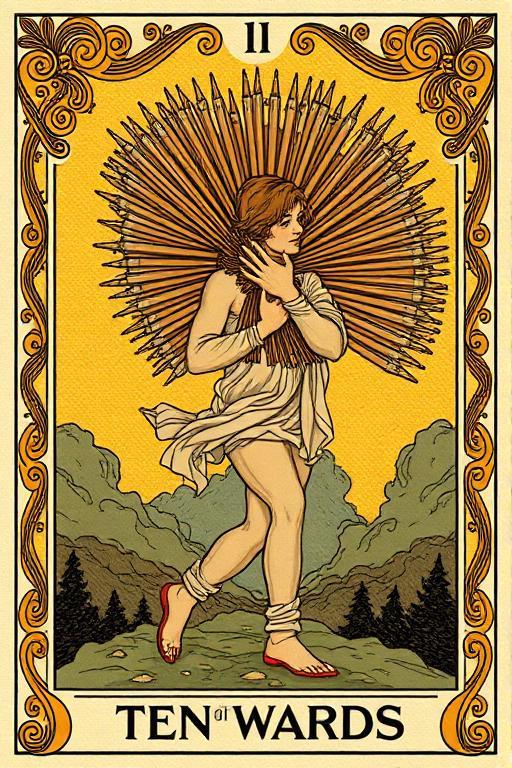
Ten of Wands – Tarot Card Meaning
Explore the Ten of Wands: A psychological perspective on burdens, boundaries, and the limits of personal responsibility in the Tarot lexicon.
Core meaning
The Ten of Wands represents the culmination of a process that has become a heavy burden. It symbolizes the point where ambition and activity have reached their limit, leading to exhaustion and the necessity of re-evaluating one's responsibilities.
Ten of Wands upright meaning
Heavy responsibilities weigh upon you. The Ten of Wands shows the burden of too much to carry. Consider what to release.
Overwhelm comes from taking on too much. It's time to delegate or release.
Success has brought heavy loads. The question is what's worth carrying.
Ten of Wands reversed meaning
Learning to delegate or release burdens. Relief is coming.
Burdens are being set down. Ask for help or let go.
The load lightens as responsibilities are shed. Freedom approaches.
Ten of Wands in love
Feeling burdened by relationship responsibilities. Communication is key.
Partnership requires redistributing burdens. Work together.
Ten of Wands in career and finances
Work overload. Delegation is necessary.
Career success brings heavy demands. Manage your load wisely.
Ten of Wands spiritual meaning
Carrying too many spiritual responsibilities. Simplify.
Spiritual exhaustion requires lightening the load. Return to essentials.
The card's advice
Assess what's truly necessary to carry. Let go of excess burdens.
Complete what must be done, then rest. The burden will soon lighten.
Ten of Wands: yes or no?
No. In a yes/no question, Ten of Wands leans towards no: look at what is holding you back or warning you.
Reflection
Psychologically, this card reflects the 'Atlas Syndrome'—the subjective feeling of having to carry the weight of the world alone. It points to a lack of boundaries and the shadow side of high achievement, where the ego's drive to complete a task leads to a loss of perspective and burnout. This archetype challenges the individual to distinguish between healthy commitment and self-sacrificing over-identification with one's duties. It invites a reflection on why one might be afraid to delegate or let go of burdens that are no longer productive.
Typical questions
- Which responsibilities am I carrying that are no longer mine to bear?
- What prevents me from asking for support or delegating tasks to others?
- Is my current exhaustion a result of external pressure or my own internal drive for perfection?
- How would my path change if I allowed myself to set down some of these 'wands'?
- Am I so focused on the finish line that I have become blind to my own physical and mental limits?
What it does not mean
This card does not signify a literal physical collapse or a predicted failure of a project. It is not a sign of external oppression, but rather an internal state of being overwhelmed by choices and commitments one has often made oneself. It should not be misinterpreted as a permanent state of suffering, but as a temporary signal for structural change.
Ten of Wands symbolism: what the card shows
The Ten of Wands in the classic Rider-Waite-Smith deck (Pamela Colman Smith, 1909) shows one person hauling ten staves at once. The bundle is clutched in front of the body, and the figure bends forward under it, head lowered so far that the wands block the view ahead. In the distance stands a house or small town, the place the load is meant to reach. Nobody else appears in the picture to share the work.
The details make the point. Ten is the end of the count, so the fire of the Wands, which began as a single spark with the Ace, has grown into more than one person can hold. The way the staves are carried matters too: gripped in an awkward armful rather than balanced on a shoulder, they cost far more effort than necessary. And because the bearer cannot see past them, the destination is close but out of sight. The card speaks less about weakness than about method. The goal is reachable; the way of carrying is the problem.
Ten of Wands reversed in love
Reversed, the Ten of Wands in love often points to an imbalance that has gone on long enough to show. In a couple, one person may be holding the calendar, the finances, the school runs or the emotional upkeep, while the other has not noticed or has stopped offering. Sometimes the reversal marks the moment it tips: a sharp remark over the dishes that is really about the last two years. It can also show relief beginning, as tasks are finally divided out loud instead of silently absorbed.
Single people may read the reversed card as a sign that there is no room for love right now, because work, family duties or a side project eat every evening. Or they bring a heavy bag of old relationship stories into every new meeting. Ask what you could set down to make space. The upright card's view on relationships is explained in the Ten of Wands love meaning.
Ten of Wands as feelings
Drawn for "how do they feel about me?", the Ten of Wands tends to describe feelings that are real but weighed down. The person may value you and still feel they have nothing left to give: deadlines, family obligations or money worries take up the space where attention to you would be. Their care may show up as duty, such as helping with practical things, rather than as romance. It can also mean that the connection itself feels like effort to them at the moment.
Reversed, the card can hint that they are starting to put some of that weight down, or that they are ready to talk about what has been too much. Treat this as a tendency to think about, not knowledge of their mind; an honest conversation tells you more than any card can.
Ten of Wands: yes or no?
No – the Ten of Wands leans towards no, especially to anything that adds weight. Someone who already cannot see past their load should not accept another staff. That is why the card puts a clear brake on questions like "Should I take on the extra role?", "Should I host the family this year?" or "Can I start the course on top of everything else?" Reversed, it remains a no to the question as you asked it, though it hints that the picture could look different once something else is handed over. Put your own question to the one-card yes or no reading.
Ten of Wands as your card of the day
As your card of the day, the Ten of Wands points to a full day and a full head. Watch for the moment you say "I'll just do it myself", because that phrase is usually where the extra staff gets picked up. Look also for tasks you have carried for weeks without asking whether they still matter. One practical step for today: write down everything on your plate, then cross out or hand over a single item before lunch, even a small one, and notice how that feels. Draw again tomorrow with the free daily tarot card.
Ten of Wands as a person
As a person, the Ten of Wands is the one everybody leans on. They take the late-night calls, cover for absent colleagues and remember which forms need signing. Their strengths are reliability, stamina and a deep sense of responsibility; projects get finished because of them. The shadow side is the belief that nobody else can do it properly, which turns helpfulness into control and quietly breeds resentment. They often find it hard to receive help and may not notice their own limits until their body or their mood sends a loud signal. When this card describes you, it asks a simple question: which of these wands did anyone actually ask you to carry?
Ten of Wands for health and wellbeing
For health and wellbeing, the Ten of Wands mirrors the bent posture in its picture: tension in the shoulders, a mind that keeps running lists at night, rest postponed until "after this week". The card does not describe an illness. It points to strain building up through habits, and to the value of spreading the load before your energy runs out. Small changes count: a fixed end to the working day, help with one recurring chore, a walk where you look up rather than down. Take this as a reflection, not medical advice; if exhaustion or pain persists, a doctor is the right person to ask.
Ten of Wands affirmation
"I do not have to carry everything to prove that I care."
"I put down what is not mine and walk on lighter."
Ten of Wands: frequently asked questions
Does the Ten of Wands mean burnout?
Many people ask this, and the card does describe the road that can lead there: too much responsibility, too little rest, no help in sight. It does not diagnose anything, and it does not say a collapse is coming. It is better read as an early signal that the current way of working cannot last, together with a nudge to redistribute tasks while you still have the energy to choose how. If you feel burned out, talking to a professional is a good step.
What does the Ten of Wands mean reversed at work?
Reversed in a career reading, the card often shows a workload starting to shift: a project ends, a colleague joins, or you finally decline a meeting. It can also show a less helpful turn, where a strained team drops tasks without telling anyone. The question is whether the load is being set down on purpose or simply sliding off. For the upright side, see the Ten of Wands in career readings.
Is the Ten of Wands a negative card?
It is a heavy card, but not a hopeless one. The load in the image exists because things grew: plans worked, people relied on you, a business took off. The trouble lies in the carrying, not the success. Next to the Four of Wands, a card of homecoming and celebration, it can ask what joy you keep postponing until the load is finally delivered, and whether it has to wait that long.