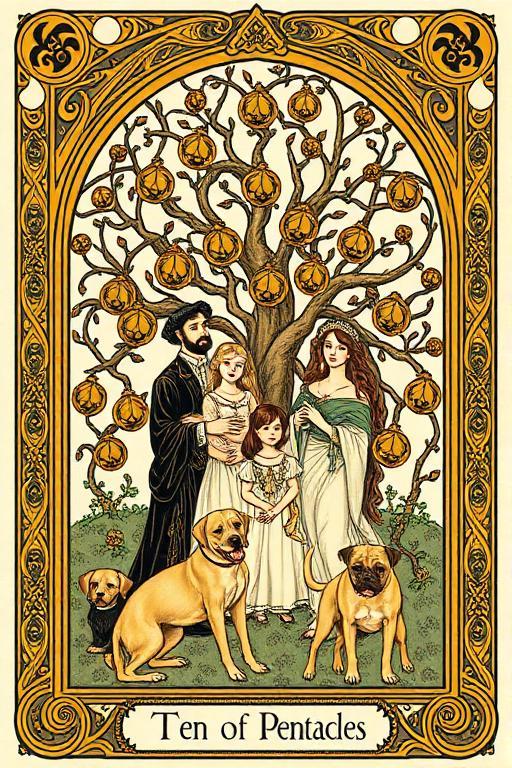
Ten of Pentacles – Tarot Card Meaning
Explore the Ten of Pentacles from a psychological perspective: Learn about legacy, transgenerational patterns, and the integration of long-term stability.
Core meaning
The Ten of Pentacles represents the culmination of material security, the establishment of lasting foundations, and the realization of long-term goals. It signifies a sense of belonging within a larger framework, such as a family, community, or tradition, where individual efforts contribute to a sustainable collective legacy.
Ten of Pentacles upright meaning
Lasting wealth and family legacy! The Ten of Pentacles shows abundance that spans generations.
Legacy of wealth and wisdom passes down. The family thrives.
Prosperity extends to all family members. What you build endures.
Ten of Pentacles reversed meaning
Family financial troubles or inheritance issues.
The family fortune struggles. Address underlying issues.
Legacy is threatened. Or wealth doesn't bring happiness.
Ten of Pentacles in love
Family and lasting love. Long-term relationship prosperity.
Partnership creates family wealth. Build together for generations.
Ten of Pentacles in career and finances
Career creates lasting prosperity. Building family business.
Work creates multi-generational wealth. Think big.
Ten of Pentacles spiritual meaning
Spiritual legacy and wisdom inheritance. Pass on what matters.
Build lasting spiritual wealth. Create legacy of wisdom.
The card's advice
Build for the long term. Create legacy that outlasts you.
Establish lasting foundations. Your efforts benefit generations.
Ten of Pentacles: yes or no?
Yes. In a yes/no question, Ten of Pentacles stands for yes: the card's energy supports what you have in mind.
Reflection
Psychologically, this card reflects the integration of the self within the context of transgenerational patterns and ancestral heritage. It invites us to examine how the values, traumas, and successes of previous generations influence our current sense of security and identity. This archetype explores the tension between honoring one's roots and maintaining personal autonomy within a structured system. It highlights the human need for continuity and the desire to create something that outlasts the individual ego. By reflecting on this card, one can identify whether they are living according to their own values or merely fulfilling a predetermined family script.
Typical questions
- What values and beliefs have I inherited from my family or culture, and which of these truly serve my growth?
- How can I create a sense of lasting stability that benefits not just myself, but those who come after me?
- In what ways do I feel supported or restricted by the traditions and structures I am currently part of?
- What does 'legacy' mean to me beyond material wealth?
- Where in my life have I achieved a state of wholeness and completion that allows me to share my resources with others?
What it does not mean
This card is not a predictive promise of a sudden financial windfall or a literal inheritance arriving in the mail. It should not be misinterpreted as a static state of perfection where no further growth is required; rather, it is about the ongoing maintenance of a complex system. Furthermore, it does not imply that material wealth is the only measure of a successful life, but emphasizes the psychological value of stability and interconnectedness.
Ten of Pentacles symbolism: what the card shows
Most Minor Arcana cards show one or two figures. The Ten of Pentacles fills the frame with three generations. In the classic Rider-Waite-Smith deck, drawn by Pamela Colman Smith in 1909, an elderly man with a white beard sits at the left in a richly patterned robe, one hand resting on one of the two dogs beside him. Further in, beneath a stone archway, a younger man and woman stand talking, and a small child holds on to the woman while looking towards the dogs. Beyond the arch you glimpse the buildings of a town.
Laid over the whole scene are ten pentacles, arranged in the pattern of the Kabbalistic Tree of Life. That arrangement matters: the coins are not piled up as treasure but spread through the picture, as if wealth were the structure the family lives inside. Pentacles are the suit of earth, of bodies, money, work and home. Ten is the number of completion, the point where a cycle is fully built. The old man is the one who started it; the child is the one it will pass to. The archway, a threshold between private house and public town, places the family inside a larger community.
Ten of Pentacles reversed in love
Reversed, the Ten of Pentacles often shows a relationship that is carrying more than two people. For couples, that can mean money and family entangled with love: parents who helped with the deposit and now expect a say in the renovation, disagreement over whether to merge finances, or a family business that one partner is expected to take over. It can also be the quieter question of whose traditions count. Which family gets Christmas, which surname the children carry, whose way of handling money is "normal".
For singles, the reversed card can point to dating with a checklist inherited from home, or to holding back because a past family break-up still shapes what feels safe. None of this is a sentence on the relationship. The card invites you to separate what you want from what you were raised to want, and to talk about money before it becomes a fight. The upright view, where love grows into a shared and lasting home, is described in the Ten of Pentacles love meaning.
Ten of Pentacles as feelings
If you ask "how do they feel about me?" and the Ten of Pentacles appears, the card tends to describe someone who is thinking long term. The person may picture you at their family table, wonder what a shared home would look like, or quietly test whether your values about money and family fit theirs. These feelings are less about butterflies and more about belonging: they see you as someone to build with. That can feel unromantic if you hoped for passion, yet it is a serious form of affection.
Reversed, the card can suggest feelings that are real but complicated by outside pressure, such as worry about how their family will react or doubts about financial security. Read this as a tendency worth exploring together, not as a window into another person's mind.
Ten of Pentacles: yes or no?
Yes – the Ten of Pentacles gives one of the most settled yeses among the Minor Arcana. It is a yes for things meant to last. It answers questions such as "Should we buy the flat together?", "Is it wise to join the family firm?" or "Should I host the family gathering this year?" especially well, because they involve commitment, shared resources and the long view. Reversed, the answer still leans yes, but the card asks you to clear up the practical side first: who pays, who decides, who inherits the obligations. You can ask your own question with the one-card yes or no tarot.
Ten of Pentacles as your card of the day
Today the Ten of Pentacles turns your attention to what you have inherited and what you are passing on. That may be a recipe, a habit of saving, a way of greeting people, or the stubbornness your grandmother was known for. Notice which of these traditions you enjoy and which you follow simply because nobody questioned them. A practical step: call or visit an older relative and ask about one story you have never heard, or sort out one piece of paperwork, such as an insurance policy or a will, that you have been putting off. When you want a fresh card tomorrow, the free daily card is ready.
Ten of Pentacles as a person
As a person, the Ten of Pentacles describes someone who thinks in decades rather than in weeks. They keep the family photos in order, know where the important documents are and feel responsible for the people around them, sometimes including relatives they rarely see. They value roots: a home that stays in the family, a firm built over years, friendships that go back to school. Their strength is reliability on a large scale; people trust them with money and with secrets.
The shadow side is that tradition can turn into a cage. They may judge others by family background, find it hard to let a younger person do things differently, or tie their worth to what they own. When this card describes you, it asks which part of your legacy you chose and which part you simply received.
Ten of Pentacles for health and wellbeing
For wellbeing, the Ten of Pentacles points to the patterns that run in families: eating habits, the way stress is handled, attitudes to rest and work. Some of these support you, such as Sunday walks or a habit of cooking together; others you may want to set down. The card also highlights the energy it takes to care for several generations at once, for example looking after children and an ageing parent in the same week. Build rest into that structure instead of waiting for a gap. This card offers a prompt for reflection only; for real health questions, including ones about family history, a doctor is the right person to ask.
Ten of Pentacles affirmation
"I keep what serves me from those before me, and I build something good for those after me."
"Security is something I create, step by step, with the people I love."
Ten of Pentacles: frequently asked questions
Does the Ten of Pentacles mean marriage or buying a house?
Many people read it that way, because the card shows a household and a home. It does not predict a wedding, a purchase or an inheritance. What it reflects is the wish for, or the stage of, building something stable together. If a marriage or a home is on your mind, the card invites you to look at the foundations: shared values, honest talks about money and how both families fit into the picture.
What does the Ten of Pentacles mean with the Ten of Cups?
The two tens describe two sides of a fulfilled home. The Ten of Cups is the emotional side, a family happy together under a rainbow. The Ten of Pentacles is the material side: the house, the savings, the structures that keep everyone secure. Together they often reflect a phase where love and stability support each other, and they ask whether you are neglecting one for the other.
What does the Ten of Pentacles reversed mean for money and career?
In work and finance, the reversed card often points to tension around shared or inherited resources: a family business where roles were never defined, a disagreement over an estate, or a career chosen to please the family rather than yourself. It can also show short-term choices that undermine long-term security. More on the upright side is in the Ten of Pentacles in career readings.