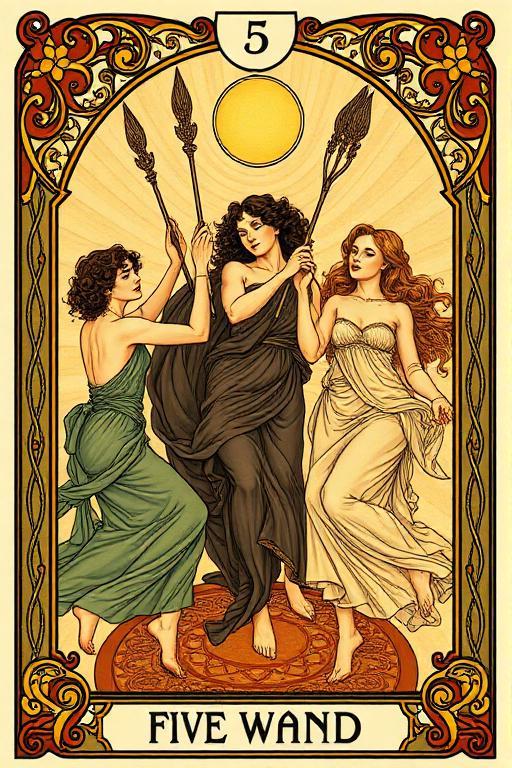
Five of Wands – Tarot Card Meaning
Discover the psychological meaning of the Five of Wands. Learn how to use competition and conflict as catalysts for personal growth and self-reflection.
Core meaning
The Five of Wands represents dynamic tension, competition, and the constructive clashing of diverse energies or ideas. It signifies a period of healthy challenge where individual wills interact, serving as a testing ground for one's own strength and convictions.
Five of Wands upright meaning
Competition and conflict arise. The Five of Wands shows creative tension—channel it productively.
Challenge sharpens ability. The heat of competition forges strength.
Multiple forces clash and compete. Navigate the struggle with skill and determination.
Five of Wands reversed meaning
Avoiding necessary conflict or escalation. Find healthy competition.
Conflict moves inside or dissipates without conclusion.
The battle exhausts without resolving. Seek a different approach.
Five of Wands in love
Tension or arguments in the relationship. Healthy debate is possible.
Relationship challenges test and potentially strengthen the bond.
Five of Wands in career and finances
Professional competition or team conflicts. Navigate carefully.
Career requires defending your position. Compete with integrity.
Five of Wands spiritual meaning
Internal struggle or conflicting beliefs. Integration is needed.
Different aspects of self compete for dominance. Seek harmony.
The card's advice
Engage with challenges constructively. Competition can drive growth.
Channel competitive energy toward achievement. Let struggle make you stronger.
Five of Wands: yes or no?
No. In a yes/no question, Five of Wands leans towards no: look at what is holding you back or warning you.
Reflection
Psychologically, this card mirrors the 'storming' phase of group dynamics or internal development, where friction acts as a necessary catalyst for growth. It reflects the ego's struggle to assert itself amidst competing influences, highlighting how resistance can refine our identity and sharpen our focus. This archetype invites us to examine our relationship with conflict: do we see it as a threat to be avoided, or as a vital energy that prevents stagnation? By engaging with this chaotic energy, we can move from mere noise to a more sophisticated harmony of integrated perspectives.
Typical questions
- Where am I currently experiencing friction, and what aspect of my ego is being challenged by it?
- How can I transform this competitive energy into a creative breakthrough rather than a power struggle?
- Am I resisting the ideas of others simply to maintain a sense of control?
- What personal strength is trying to emerge through the current external pressure?
- How can I participate in this 'battle of ideas' without losing my internal balance?
What it does not mean
This card does not signify serious aggression, permanent enmity, or a destructive defeat. It should not be misinterpreted as a warning of malicious intent or a sign that a situation is hopeless. Unlike cards of true crisis, the Five of Wands represents the non-malicious, often playful or developmental nature of competition and should not be used to predict actual physical or legal battles.
Five of Wands symbolism: what the card shows
In the classic Rider-Waite-Smith deck, drawn by Pamela Colman Smith in 1909, the Five of Wands shows five young people, each holding a long staff, swinging them in what looks like a brawl. Look more closely and nobody is hurt or falling. The staves cross in the air, the figures are dressed differently from one another, and Waite himself described the scene as mock fighting, somewhere between sport and strife.
That ambiguity is the heart of the card. The five figures are not an army against an enemy; each seems to follow their own plan, so the result is noise rather than a battle. Wands belong to fire, the element of will and ambition, and five is the number of disruption in every suit: the stability of the Four is shaken up. Here it is shaken by too many wills at once. The different clothing hints that every person brings their own background and agenda. The card asks whether this is a contest that sharpens everyone, or just a lot of energy spent in circles.
Five of Wands reversed in love
Reversed, the Five of Wands in love is often less about shouting and more about silence. The arguments have stopped, but not because anything was settled: one partner gave up on the topic, or both learned to steer around it. The weekly fight about chores turns into a cold distribution of tasks; the debate about where to spend the holidays turns into separate plans. On the surface it looks calm, yet the friction has only moved underground.
For singles, the reversed card can describe dating as a competition you no longer want to play: comparing yourself with others in the apps, or dropping out the moment interest becomes mutual and therefore a little risky. It can also point to rivalry fading because you have stopped trying to win someone who keeps you guessing. In both cases the card is not a sentence passed; it suggests naming the conflict calmly, one topic at a time. Its upright side is explored in the Five of Wands in love and relationships.
Five of Wands as feelings
If you ask "what do they feel for me?" and draw the Five of Wands, the card points to feelings with friction in them. The person may be drawn to you and irritated by you in equal measure, enjoy debating with you, or feel a kind of rivalry that keeps the attraction lively. Sometimes the conflict is inside them: they want closeness and also want to stay independent, and that tug-of-war shows as mixed signals.
Reversed, the card can mean they are tired of the back-and-forth and want peace more than intensity, or that they avoid showing feelings to escape a fight. Treat all of this as a tendency, not as a reading of another person's mind; what someone really feels, only they can tell you.
Five of Wands: yes or no?
No – the Five of Wands leans towards no, because the situation behind your question is still contested. Too many interests, opinions or obstacles pull in different directions for a clean result right now. The card is especially telling for questions like "Will the team agree to my proposal?" or "Should I enter this competition today?" where the answer depends on others. Reversed, it stays a no, but with a hint that the dispute is winding down and a better moment may come once the noise settles. To ask another question, try the yes or no tarot.
Five of Wands as your card of the day
As your card of the day, the Five of Wands prepares you for a lively, perhaps slightly chaotic day. Meetings where everyone talks at once, group chats with five opinions, a sibling who wants to argue about something small. Watch whether a disagreement is actually about the topic or about who gets the last word. A small practical step: before you answer in a heated discussion, repeat back what the other person said in one sentence. It often turns a scrum into a conversation. You can draw a new card tomorrow with the daily card.
Five of Wands as a person
As a person, the Five of Wands describes the sparring partner. This is someone who loves a good debate, plays team sports with real passion and brings energy to any brainstorming session by questioning everything. They are competitive, quick and honest, and they often bring out the best in others simply by refusing to accept a lazy idea. The shadow side appears when every conversation becomes a contest. They may argue for the sake of it, find it hard to concede a point, or create friction when the group really needs calm. Their growth lies in knowing which battles are worth the energy and which are just habit.
Five of Wands for health and wellbeing
For wellbeing, the Five of Wands often reflects scattered energy: too many demands competing for the same hours, and a body that feels restless rather than tired. Physical outlets can help here, such as a team sport, a run or anything that lets competitive energy out in a healthy way. It can also be worth noticing whether constant small conflicts at home or at work leave you tense in the evening. The card offers food for thought, not medical advice; if your health concerns you, see a doctor.
Five of Wands affirmation
"I can disagree without having to win, and listen without having to give in."
"I put my energy into the contests that truly matter to me."
Five of Wands: frequently asked questions
Is the Five of Wands a bad card?
Not really. It is one of the more uncomfortable cards, because it shows friction, but the friction is not hostile. Nobody in the scene is defeated. The card often describes a phase of healthy competition, creative argument or growing pains in a group. It becomes difficult only when the conflict has no goal and nobody steps back to ask what it is for.
What does the Five of Wands mean for a decision?
When you are torn between options, the card often mirrors the noise in your head: several voices, each with a good argument, and none leading. It suggests taking the debate outside, writing down each option's case, or letting one trusted person challenge you. Deciding becomes easier once you know which voice is really yours. More in the Five of Wands for decisions.
What does the Five of Wands mean with the Six of Wands?
The pair tells a short story: struggle, then a win. The Five shows the scramble of competition; the Six of Wands shows the rider who comes out of it recognised. In a reading the combination often suggests that the current friction can lead to a visible success, provided you keep your focus on the goal rather than on the rivals around you.